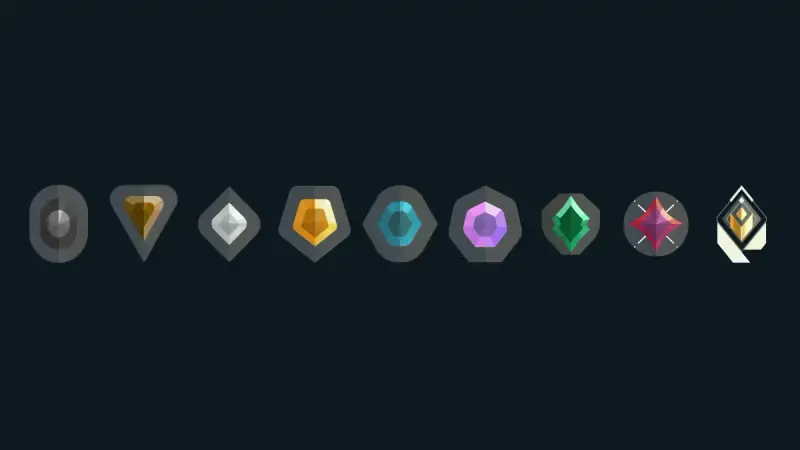
Climbing in VALORANT's Competitive mode takes more than memorizing the tier names: you need to know how RR works, when you can drop, and which rules apply when you queue as a group. This guide collects the rules from Riot Games' official support pages in one place, rechecked on October 11, 2026. The numbers are the ones Riot publishes; they can change between seasons, so it is worth confirming the current version in-game as well.
Nine Tiers, Three Steps Each
The ladder has nine tiers: Iron, Bronze, Silver, Gold, Platinum, Diamond, Ascendant, Immortal and Radiant. Every tier except Radiant has three steps (for example Gold 1, Gold 2, Gold 3); Radiant is a single step. That makes 24 steps from Iron 1 to Immortal 3, with Radiant on top.
Unlocking Competitive and Placement Matches
According to Riot's FAQ, your account must be at least level 20 to access Competitive mode. To set your rank you play 5 placement matches at the start of Act 1 and Act 4; in Acts 2, 3, 5 and 6, players who already finished their first placements need only one placement match. The highest rank you can reach through placement is Ascendant; Riot's pages state it as Ascendant 1 in one place and Ascendant 3 in another.
Progress Through RR
Progress is measured in Rank Rating (RR). The basic rules are:
- After placement you start with 50 RR.
- You need 100 RR to move up a step, and after a promotion you begin the new step with at least 10 RR.
- Winning or losing affects RR the most; margin of victory, standout performance and being the underdog can also matter.
If your hidden MMR is above your rank, wins give more RR than losses take away; if it is below, the opposite is true. Going AFK or dodging the queue for a prolonged period also lowers your RR.
Demotion and Rank Shields
To drop a step you must first reach 0 RR and then lose again; after a demotion you start the lower step with at least 70 RR. When you enter step 1 of a tier (by promotion or demotion) you gain 2 Rank Shields. If you lose at 0 RR, a shield prevents the drop out of the tier and is used up instead, but it does not stop drops within a tier such as Silver 2 to Silver 1. Dodging or remaking a match does not use a shield.
Immortal and Radiant
Above Ascendant, RR accumulates with no cap, and Immortal 1 starts at 10 RR. Immortal 2, Immortal 3 and Radiant have RR thresholds that differ by region. To reach Radiant you must pass your region's Radiant threshold and also be in the top 500 players of your region; meeting only one keeps you in Immortal 3. There are no performance bonuses in Immortal and Radiant, so RR depends only on the match result. To stay on the leaderboard you need at least one Competitive game every 7 days. There is no rank decay.
Party Rules and Act Rank
In parties of two or three, the rank gap between players is limited (for example, if the lowest player is Gold, the highest can be Platinum). Groups of four are not allowed, and players at Immortal 1 or above can only queue solo, as a duo or as a five-stack. In a five-stack that includes an Immortal player, RR gains are reduced by 25%. Your Act Rank comes from the highest rank you held in a win during that Act, and you must win at least 9 Competitive games in an Act to earn the badge and ranked rewards. The badge border develops at 9, 25, 50, 75 and 100 wins.
You can learn how to unlock Competitive on your account in our rank unlocking guide and find general gameplay advice in our beginner's guide.