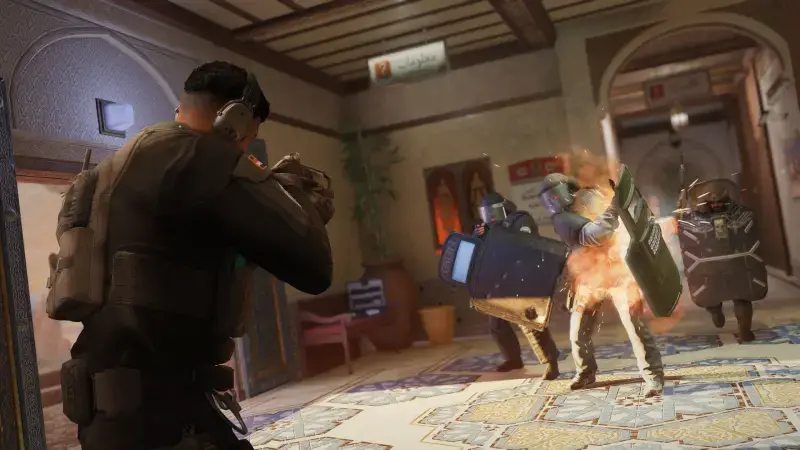
Rainbow Six Siege is one of those games that scares people off in their first match: you walk through a door, die without knowing where the shot came from, and watch the rest of the round. Yet the logic of the game can be understood with a few basic rules. In this guide, based on Ubisoft's own explanations, we've collected how a round works, what to do in the preparation phase, the game modes, operator roles and the most suitable starter operators for a new player. The goal is to turn your first ten matches from a blind brawl into a conscious learning process.
Attack and Defense: The Logic of a Round
Siege is a five-versus-five tactical shooter in which the sides switch every round. Ubisoft sums it up as "a battle between fortification and breaching": the defending side turns the objective room and its surroundings into a fortress, and the attacking side looks for a way into it. Rounds are short and you have a single life; once you die, you keep feeding your team information through cameras or drones until the round ends. The match ends when a team wins a set number of rounds, and in one match you play both attack and defense.
What sets the game apart from other shooters is destruction. In Ubisoft's words, you "turn walls into windows of opportunity": soft walls, floors and ceilings can be broken, new lines of sight opened, and fire exchanged between floors. That's why holding a room in Siege isn't just holding the door; it means accounting for every wall, ceiling and floor that leads into that room.
Preparation Phase: Drones, Reinforcements and Barricades
Every round starts with a preparation phase. As Ubisoft describes it, attackers scout with remote drones during this time: they learn the enemy's positions, the objective location and the fortifications set up. Defenders, meanwhile, fortify the objective area: they seal walls with metal reinforcements, barricade doors and windows, and place traps and cameras. The first rule for a new player is simple: on attack, keep your drone alive until it finds the objective room and, if possible, hide it in a corner to use again during the action phase; on defense, reinforce the outer walls of the objective room, but don't seal every wall and cut off your team's rotation routes.
Game Modes and Playlists
All competitive playlists revolve around the same three objective types; Dual Front, which arrived with Siege X, uses a separate structure:
- Bomb: Attackers plant a defuser on one of two bombs; according to Ubisoft's guide, once activated the defuser takes 45 seconds to disarm the bomb and must be protected during that time. Defenders win the round by stopping the defuser or eliminating the attackers. This is the only mode in Ranked.
- Secure Area: Attackers must find the room housing the biohazard container and stay inside it, uncontested, for at least 10 consecutive seconds.
- Hostage: Attackers find the hostage and carry them to the extraction point; the side that harms the hostage can lose the round, so explosives are used with care.
- Dual Front: The 6v6 mode introduced with Siege X. Both teams attack and defend at the same time: you try to capture the enemy's sectors while protecting your own, and you respawn when you die.
Among the playlists, Quick Match is the fastest way in, while Standard is played with Ranked rules but without rating pressure. According to Ubisoft's description on the Steam page, Quick Match and Standard (still referred to there as "Unranked") are free to access, while Ranked playlists, Siege Cup and additional operators require the paid edition. The same page mentions a new "clearance level" path that teaches new players the basics step by step; in your first hours it makes sense to use that path and matches against AI such as Versus AI.
Operator Roles
In Siege every operator has a unique gadget, and in its official operator list Ubisoft classifies operators with role tags based on those gadgets. The tags are:
- Breach: Those who make a path for the team by opening walls, floors and barricades; those who can open reinforced walls are the "hard breach" operators.
- Anti-Gadget: Those who disable or destroy the enemy's gadgets, cameras and traps.
- Intel: Those who reveal enemy positions and gather information with cameras and scanning tools.
- Trapper: Defenders who punish entries by setting traps.
- Support: Those who give the team armor, healing or protection.
- Front Line: Fast operators with strong weapons who enter the room first or meet the enemy first.
- Map Control: Those who control a large part of the map by holding corridors and rotation routes.
- Crowd Control: Those who slow, disorient or keep the enemy away from certain areas.
- Anti-Entry: Defenders who block entries or make entering costly.
These tags aren't rigid classes but hats describing what the team needs in a round; the same operator can carry more than one tag. For example, Thermite is attack's core Breach operator because his exothermic charge opens reinforced walls, while Twitch carries both the Anti-Gadget and Intel roles because her shock drone destroys enemy gadgets and scouts at the same time. Having at least one hard breacher, one Anti-Gadget and one Intel operator when building a team is the basic condition for an attack to get into the objective room.
Starter Operators for a New Player
Ubisoft offers a separate "Starter Operators" filter in its operator list, and in the Starter Edition it used to sell, new players received two operators chosen at random from a pool of six that Ubisoft had "determined to be the most intuitive for entry-level players". The six operators in that pool are still the easiest starting points to learn:
- Attack: Sledge (opens soft walls and floors with his hammer; using the gadget isn't complicated at all), Ash (enters fast with her remote breaching rounds and has a strong weapon) and Fuze (throws cluster charges through walls; needs care in Hostage because he can harm the hostage).
- Defense: Rook (drops armor plates for the team at the start of the round, then simply holds the objective), Mute (blocks drones and remote breaching gadgets with his jammers) and Smoke (delays the defuser plant with his toxic gas canisters).
Five Tips for Your First Matches
- Use the shooting range and matches against AI before facing real players; learn your aim sensitivity and the room names of at least two maps there.
- On attack, drone first, then enter. Entering the building without having seen the objective room is the moment new players die most often.
- On defense, spend reinforcements on the objective room; the number of reinforcements in the team pool is limited and one spent on the wrong wall doesn't come back.
- Don't run, listen. In Siege, footsteps and destruction sounds are the most reliable information about an operator's position; use the lean key when turning corners.
- Play dozens of matches with the same two or three operators. Learning the role tags and the maps gets you further, faster, than trying a new operator every match.
Conclusion
A round in Rainbow Six Siege is a clash between the defense's fortification and the attack's scouting and breaching effort. Using the preparation phase well, knowing the objective types and reading operators through their role tags is the biggest gain of the first weeks. If you start with mechanically simple operators like Sledge, Ash, Rook and Mute and build up your sound and drone discipline, your matches stop being a blind brawl.
Once the basics are in place, take a look at our Rainbow Six Siege rank system guide to prepare for the competitive playlist, and read our Siege X settings article for high frame rates on your PC.