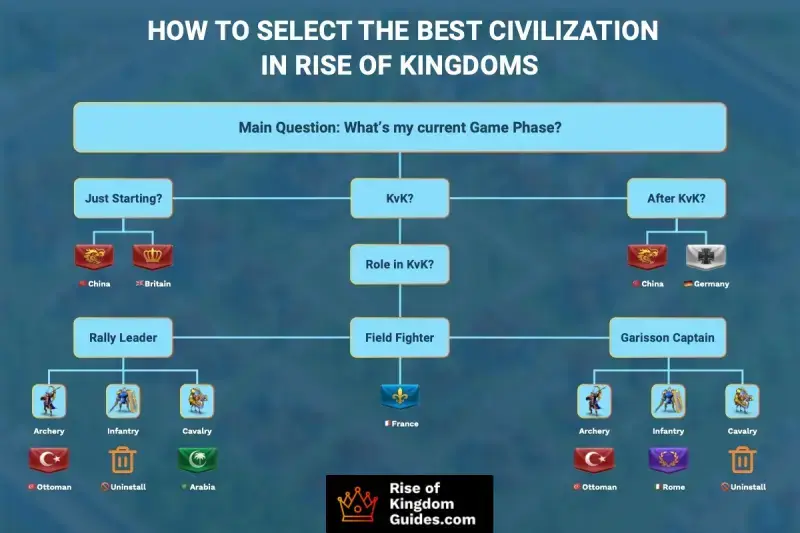
In Rise of Kingdoms, the civilization you pick when you first start playing has a far longer-lasting impact than most players expect. This choice doesn't stay a matter of just a few percentage points of bonus; it determines which commanders you'll use more efficiently, which troop type your army will be strengthened in, and which role you'll stand out in during enormous events like KvK. In this article, we go through the updated 2026 civilization tier list from start to finish, the concrete bonuses of each nation, and which choice makes sense at which stage of the game. Our goal isn't to force a single "correct answer" on you; it's to help you make a conscious decision that fits your own playstyle.
The common ground in community experience is this: in Rise of Kingdoms, your civilization choice isn't a one-time, unchangeable decision. A civilization that works perfectly at the start of the game may not deliver the benefit you expect during the KvK period, because your needs change. While building structures and gathering resources are the priority in the early game, roles such as field fighting, rally leadership or garrison captain come into play later on. That's why the real answer to the question "what is the best civilization" ends up at the same door as the answer to "at which stage, for which role."
Why Does Civilization Choice Shape the Course of the Game So Much?
In Rise of Kingdoms, civilizations can be considered the backbone of the game. That's because many decisions, from your army composition to your commander investments, from your resource production speed to your standing within the alliance, are shaped by the bonuses your chosen nation provides. If you want to follow a specific strategy, starting with a civilization compatible with that strategy can save you weeks, even months. Conversely, if you make a choice that doesn't suit your style, you often only notice the difference in big wars like KvK, after it's too late.
It's possible to group civilizations roughly by three purposes. For those who want to grow their city, establish a sprawling settlement and set up a strong trade order, development-focused nations stand out. In this group, France is shown as the strongest candidate with its building, resource and healing bonuses alike. For players whose main goal is to fight, build an army and defeat their enemies, war-focused options such as Germany, Britain, Korea, Arabia, the Ottoman Empire and Byzantium are recommended. For those who want to both improve their city and make a showing in battles, Rome, Spain, China and Japan offer a balanced middle path.
The nuance to watch out for here is that your playstyle should also guide your civilization choice. If you're someone who wants a calmer, more orderly game, France, Spain or China will suit you better. If you like a constantly fighting, active and aggressive playstyle, picking one of the war-focused civilizations makes far more sense. When you get this match right from the start, your need to deal with forced civilization changes later in the game drops significantly as well.

2026 Updated Civilization Tier List
The table below summarizes the tier ranking considered valid as of 2026 and the most suitable use case for each civilization. The tier letters reflect not a civilization's overall power but its success in its own area of expertise; that is, a C-tier nation can still get the job done when used in the right role.
| Civilization | Tier | Best Use |
|---|---|---|
| Arabia | S | Rally (mass attack) leadership |
| Ottoman Empire | S | Rally (archer-heavy attack) |
| Vikings | S | Defense |
| France | S | Field fighting |
| Rome | A | Defense and garrison |
| Germany | A | Troop training and action point recovery |
| Britain | A | Archer field fighting |
| China | B | Defense (and early game development) |
| Korea | B | Technology research |
| Byzantium | C | Cavalry field fighting |
| Japan | C | Resource gathering |
| Spain | C | Commander leveling up |
When you look at the table, you can see that S tier is spread across four different specialties: Arabia and the Ottomans are shown at the top for rally leadership, Vikings for defense, and France for field fighting. In A tier, Rome is highlighted for defense and garrison, Germany for troop training and action point recovery, and Britain for archer field fighting. In B tier, China is evaluated on the defense side and Korea on technology research; in C tier, Byzantium is listed for cavalry field fighting, Japan for resource gathering and Spain for commander development.
The most critical message of this ranking is this: the tier letters don't express absolute superiority, because every civilization answers a specific need. For example, Japan, which appears in C tier, can be an extremely practical choice for resource-gathering alt accounts. Likewise, Spain is tailor-made for new players who want to level up their commanders quickly. So reading the list not as "good and bad" but as "which tool for which job" is much healthier.

What Is the Most Sensible Starting Choice for New Players?
Rise of Kingdoms features historical civilizations rather than factions, and for beginners the choice really comes down to two candidates: China and Britain. The reason these two stand out is that what you need most in the early game is building speed, action points and commander access. Since you'll be constantly putting up buildings on a new account, the building speed bonus pays off almost every hour, and the action points you spend roaming the map gathering resources become your scarcest resource.
There are several concrete reasons China stands out in this picture. When you choose China, you get a 5% building speed bonus and 5% action point recovery; on top of that, Sun Tzu is regarded as one of the best epic commanders in the game. China's special unit is the Chu Ko Nu, and although its stats aren't spectacular, it provides 3% troop defense, 5% action point recovery and 5% building speed. Thanks to Sun Tzu's defense-heavy structure, it becomes seriously difficult for enemies to reach you in the early game.
Britain, meanwhile, stands out as the second and alternative choice. With a strong commander like Boudica and the Longbowman special unit, Britain offers 5% archer attack, 5% troop training speed and 20% garrison allied capacity. Boudica is described as a reliable commander in both player-vs-player and player-vs-environment matches, and she becomes far more effective when her talent tree is built correctly. However, her weakness in rage generation and reduction, plus her focus on just a single troop type, sets her long-term limits. That's why Britain is generally seen as a good start, yet the number of players who want to switch to China later on is not to be underestimated. For those who want to keep things simple in the early game, the most practical advice is to stay with China.
This pair isn't the only alternative for beginners. Rome stands out as a nation where even novice players can develop comfortably thanks to strong defense bonuses and resource gathering speed; it gives the feeling that you're almost automatically protected. Spain, meanwhile, is ideal for those who want to level up their commanders fast thanks to its 10% barbarian experience bonus. France, with its 20% healing speed and 10% wood gathering bonus, appeals to new players who play resource-focused.
Choosing a Civilization by Role During KvK
In the KvK (Kingdom vs. Kingdom) stage, the best civilization becomes directly tied to the role you take on in the event. That's why, before making your final decision, you need to ask yourself a few clear questions: Will I be a field fighter or a rally leader? If I'm going to be a rally leader, which troop type will I open rallies with? Or is the garrison captain role better suited to me? The answers to these questions determine your civilization choice almost by themselves.
Field fighter: France
Players who take an active role in field fighting consume a lot of healing speedups, and those run out fast. Switching to France to benefit from the 20% hospital healing speed bonus eases this problem to a great extent. France's special unit is the Throwing Axeman, which provides 3% troop health, 10% wood gathering speed and 20% healing speed. Its commander Joan of Arc Prime is considered one of the best epic commanders for her versatility in gathering, player-vs-player matches and events; she is especially valuable in events like Sunset Canyon, Golden Kingdom and Lost Canyon.
If you're not a field fighter, rally leader or garrison captain: Germany
For players who don't get into intense field fighting, meaning those who don't burn through healing speedups, Germany is a very good choice. Germany gives 5% troop training speed, 10% action point recovery and 5% cavalry attack, which means serious value during and after KvK. Having a special cavalry unit also helps in every situation. Germany's commander Hermann is known for tremendous rage generation; thanks to this, his active skills trigger very often and he is mentioned in the guide as a strong archer commander. Germany's special unit, the Teutonic Knight, adds 10% action point recovery on top of 5% cavalry attack and 5% troop training speed.
Rally leader: Arabia
For players who open rallies, Arabia is shown as the first choice. The reason is that it offers a powerful bonus that increases the damage dealt by rally armies by 5%. Arabia's commander is Baibars, who boosts the civilization's cavalry attack power and the damage dealt by the army, making it extremely valuable for those who play war-focused. Since damage output in rally leadership directly determines the outcome of the battle, this percentage increase, though it looks small, turns into a serious advantage in large-scale wars.
Archer rally leader: Ottoman Empire
If you're going to lead rallies but play archer-heavy, the Ottoman Empire stands out as an alternative option. The Ottomans provide 5% archer health and 5% skill damage. Along with its commander Osman, faster archers and march speed come with it. However, the guides' warning is clear: the Ottoman Empire is considered one of the weakest civilizations in the game and the benefits it offers remain limited. So it makes sense to choose it only in a very specific role like archer rally leadership.
Infantry garrison captain: Rome
Rome is recommended for infantry players who serve as garrison captains. When Rome is chosen, you get 5% infantry defense and 5% troop march speed; there is also an increase in food gathering speed (reported as 10% in one part of the guide and 5% in another). Rome's special unit, the Legionary, and its commander Scipio Africanus are extremely effective on the battlefield as an infantry commander. Thanks to his powerful skills, he makes enemies think twice before going on the attack.
What Should You Do in the Post-KvK Period?
After KvK ends, most players have completed their strong buildings and no longer need China's building speed bonus as much. If you think you still have building work left to do, you can stay with China; but if that need has disappeared, switching to Germany, widely considered the best civilization overall, is the healthiest move. Troop training speed is extremely good, action point recovery is even better, and the cavalry unit stays solid in every situation. All these features make Germany the strongest choice for the periods between KvKs.
For those who say, "I don't want to deal with all this civilization-changing business, I'll just carry on with one," the answer is again Germany. It is shown as the best choice for most players: its troops are great, its action point generation is superb and it offers a reasonable balance on both the war and development sides. So if you've decided to stay with a single civilization, this is the choice you're least likely to regret later on.
Let's Take a Closer Look at the S-Tier Civilizations
Looking one by one at the civilizations at the top of the tier list is useful for understanding why they hold that position. The common feature of the four nations in this group is that they offer bonuses that can be considered irreplaceable in a specific role. But remember: being S tier doesn't mean that civilization is the best in every scenario.
Arabia is indisputably the standout when it comes to rally leadership. Its bonus that increases the damage dealt by rally armies by 5% makes a serious difference in large-scale coordinated attacks. Together with its commander Baibars, it raises cavalry attack power and the army's damage capacity, which makes it a natural choice for war-focused players. If your alliance opens rallies often and you're at the head of those rallies, Arabia's return is felt almost instantly.
The Ottoman Empire, though it appears in S tier, is actually an extremely niche option. The 5% archer health and 5% skill damage increases work in archer rallies; faster archers and march speed are a bonus on top. But in overall evaluation it is named as one of the weakest civilizations in the game and the range of benefits it offers stays narrow. So if you're going to choose it, you need to be sure that you really will only be doing archer rally leadership.
The Vikings are placed in S tier in the defense category in the table. The source guide doesn't give a detailed bonus breakdown for the Vikings; so it wouldn't be right to talk in exact numbers. However, being shown at the top of a defense-focused ranking indicates that it carries serious potential in siege and garrison scenarios. If you're a player who centers on the defense role, you can note the Vikings as an option worth testing on your own account.
France, meanwhile, is the S tier of the field fighting category. The 20% hospital healing speed is an almost life-saving bonus for players who fight constantly, because the biggest hidden cost of field fighting is healing speedups. On top of that come 10% wood gathering speed and 3% troop health. Joan of Arc Prime is shown among the best epic commanders for her versatility in gathering, player-vs-player matches and events. Despite her low march speed and modest stats, the support she provides makes her an always-usable option.
A Tier: Balanced and Versatile Choices
A-tier civilizations offer a broad range of benefits rather than specializing in one particular area. Rome is strong on the defense and garrison side; with an infantry structure under Scipio Africanus and the Legionary unit, it provides an environment where even new players can develop comfortably. When 5% infantry defense, 5% march speed and a food gathering speed bonus come together, a solid package emerges for those who want to both grow their city and stay standing in battle. For those just learning the game in particular, Rome functions almost as an automatic protective shield.
Germany is perhaps the most recommended member of A tier. Its 5% troop training speed, 10% action point recovery and 5% cavalry attack bonuses pay off at almost every stage of the game. The Teutonic Knight special unit offers solid stats and provides a natural advantage for cavalry-heavy players. Another strong side of Germany is that it enables fast growth and, with its increased attack capacity, makes farm hunting easier. Still, there's a warning: such an aggressive setup can leave you overly exposed to attacks in the early game. If you prioritize attack power, Germany is just right for you.
Britain, meanwhile, is evaluated in A tier for archer field fighting. The Longbowman special unit increases archer attack by 5%, troop training speed rises by 5% and garrison allied capacity increases by 20%. Boudica is described as a reliable commander in both player-vs-player and player-vs-environment matches; with her strong talent structure and commander pairings she adds serious value to your game. Her weak points are low rage generation and her focus on only a single troop type. Even so, Britain, with its balanced structure offering both attack and defense, remains a strong choice, especially for new players.
B Tier: Niche Bonuses and Special Use Cases
Although China sits in B tier, it keeps its title as the most recommended civilization for beginners. The stats of the Chu Ko Nu special unit aren't impressive, but they aren't bad either: it provides 3% troop defense, 5% action point recovery and 5% building speed. Sun Tzu is one of the game's best-known commanders and, thanks to his defense-focused structure, makes it hard for enemies to reach you. The reason China appears in B tier isn't weakness; it's that its bonuses are focused on early game development and are less useful in war-heavy periods like KvK.
Korea, meanwhile, is listed in B tier for technology research. Led by Eulji, Korea has the Hwarang special unit; it offers 5% archer defense, 15% hospital capacity and 3% research speed. The research bonus is valuable, especially for long-term accounts, because it saves serious time in the technology tree. Korea has a structure built on defense and in this respect offers one of the best defenses in the game. But there's a point the guides highlight: Korea's real significance emerges through research speed for high-spending players. For an average player its benefit can remain more limited.
C Tier: Limited But Useful in Specific Jobs
Byzantium sits in C tier and its commander is Belisarius. The benefits it provides are limited: apart from stone gathering speed and increased hospital capacity, it doesn't offer a notable advantage. It also contributes on the cavalry training side. So Byzantium should be considered not as a general choice but for a very specific need like cavalry field fighting. If you're building your civilization choice on a long-term strategy, Byzantium will probably be at the bottom of your list.
Japan is listed in C tier in the resource gathering category. Its commander is Kusunoki and its special unit is the Samurai, providing 3% troop attack, 30% march speed and 5% gathering speed. These stats are actually quite solid; the 30% march speed in particular is a great convenience for scanning the map quickly and identifying safe zones. Japan is said to be strong on tactical awareness and strategy development. But community advice is clear: use Japan only on farm accounts, don't pick it for your main account. Thanks to the gathering speed bonus it can be a reasonable start for new players, but it isn't a long-term investment.
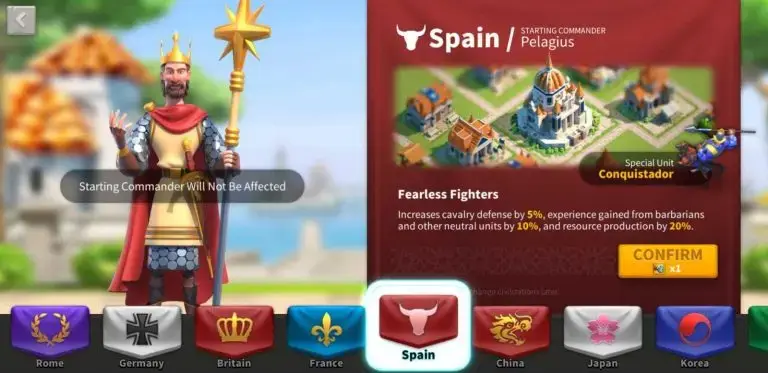
Spain, meanwhile, stands out in C tier for commander leveling. Its commander is Pelagius and its special unit is the Conquistador, providing 5% cavalry defense, 10% barbarian experience and 20% resource production. This combination is quite appealing for new players: they can level up their commanders quickly and develop their cities fast thanks to resource production. In addition, the cavalry defense bonus protects you against enemy attacks in the early game. So if you want to grow fast and strengthen your commanders as soon as possible, Spain still stands as a sensible option.
Is Changing Civilization Worth It, and How Do You Do It?
The question "Why would I bother changing civilizations?" is one that comes up often, especially from experienced players. The most honest answer is this: different civilizations offer different advantages you can use at different stages of the game. Changing civilization can seem like a lot of effort for a small return in the short term; that impression is accurate if you're only looking at a very short time window for that "micro-optimization." But if you're someone who plans to play Rise of Kingdoms for many years, changing civilization becomes one of the best decisions you can make.
Now let's get to how it's done. The critical warning is this: don't spend 10,000 gems to change civilization. Instead, go to the alliance shop and buy "Civilization Change" with your individual credits. Most players save their individual credits to buy a migration passport; but if you're not planning to migrate, spending your credits for this purpose makes perfect sense. The source guide also notes that a civilization change can be made for 10,000 gems or 2,000,000 alliance currency; so you can act according to whichever resource you have. Sometimes gems won through in-game codes can help cover this cost.
Before your civilization change decision, ask yourself one more question: what stage are you at right now and which role are you taking on? In the early game, a development-focused choice like France, Spain or China can carry you forward. As KvK approaches, if you're a field fighter France stands out, if you're a rally leader Arabia, if you're a garrison captain Rome, and if you play general-purpose Germany. So the change should be made not because "it's the trend," but because your needs have genuinely changed.
Conclusion: Which Civilization Suits You?
In Rise of Kingdoms, civilization choice is one of the game's most fundamental strategic decisions, and how correct that decision is depends largely on how well you know yourself. If you want to stay with a single civilization without dealing with anything else, Germany stands out as the safest harbor: troop training speed, action point recovery and solid cavalry pay off at every stage. If you're just starting out, beginning with China seriously eases your first weeks thanks to Sun Tzu's defensive power and the building speed bonus.
If you're someone who loves field fighting, France's healing speed offers a permanent solution to the hassle of wrestling with healing speedups. If you lead rallies, Arabia strengthens your coordinated attacks with its damage bonus. If you're on the garrison and defense side, Rome or the Vikings are options you can evaluate according to your needs. For novices who want to level up their commanders fast, Spain; for resource-gathering alt accounts, Japan; for accounts investing in research speed, Korea still serves a particular function. What matters is that, instead of blindly looking at the tier letter, you clearly define your own role and your position in your game universe and make a choice that fits it. Once you strike this balance, civilization choice becomes not a decision that restricts your game but, on the contrary, an advantage that carries you forward.