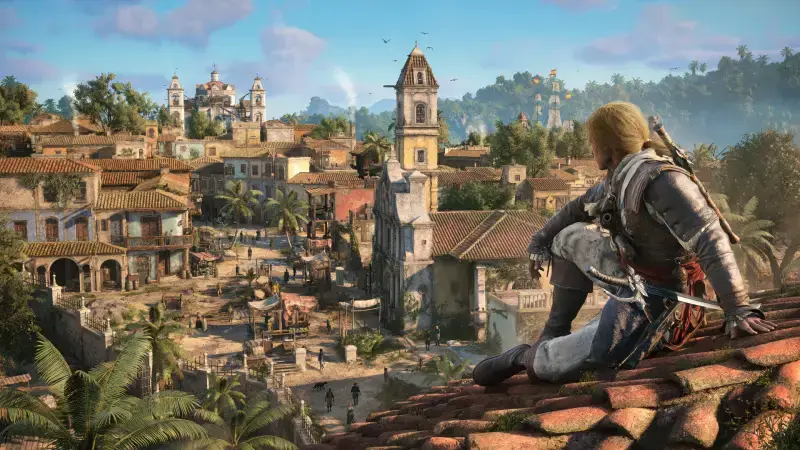
There is a scenario PC gamers have memorized for years: a big-budget production launches, and in the first days, stutters, dropping frame rates, and driver issues dominate the agenda. Assassin's Creed Black Flag Resynced, however, seems to have managed to reverse this pattern. Running on the current version of Ubisoft's Anvil Engine, the game gives a polished impression even at launch and strikes a playable balance on both powerful and reasonable systems. Extensive tests reveal a performance chart where AMD cards stand out, while on the NVIDIA side, things are also on track. So what do these results mean in practice, and what does which hardware deliver at which resolution? Here is the detailed performance picture of the launch version.
Test setup: which hardware and which method were used?
The backbone of the measurements consists of an AMD Ryzen 9 7950X3D processor and 32 GB of DDR5 memory running at 6000 MHz. On the graphics card side, there is a wide range: from AMD, Radeon RX 6900XT, RX 7900XTX, and RX 9070XT; from NVIDIA, RTX 2080Ti, RTX 3080, RTX 4090, RTX 5080, and RTX 5090. Tests were conducted on Windows 10 64-bit with GeForce 610.74 and Radeon Adrenalin Edition 26.6.4 drivers. This wide range of cards is valuable for seeing how both older generation and current generation hardware is positioned, because most gamers use a card that is two or three generations old.
Framerate data was collected with the game's own built-in benchmark tool. Such tools can sometimes be weak at reflecting real gameplay; however, here it is stated that the tool represents in-game performance, so there is a reasonable justification for trusting the results. All measurements focus on rasterized performance with ray tracing off; a separate review has been conducted for those interested in RT and DLSS 4.5. This distinction is important because to see the game's basic performance character, one must first understand the rasterized picture.
Graphics settings, upscaler support, and ray tracing options
Ubisoft has filled the settings menu in a way that frees the player's hand. Many parameters such as textures, shadows, view distance, terrain detail, and reflections can be adjusted separately. This flexibility is a significant advantage, especially for players who like to tweak settings one by one to save FPS on mid-range cards. Additionally, the game offers ray tracing support for global illumination and reflections; so owners of next-gen cards can push visual quality up another notch.
Even more remarkable is the support for all three major upscalers: NVIDIA DLSS 4.5, AMD FSR 4.1, and Intel XeSS 3.0. The presence of all three means the player can choose the most suitable solution for their hardware, regardless of brand. At high resolutions, upscaler support has become not a luxury but almost a necessity; because native 4K pushes even the most powerful cards to their limits. Still, there is a point that should not be forgotten: an upscaler is not magic, it is a tool that gains frame rate by reconstructing the image — so one must choose knowingly which mode brings which visual compromise.
Performance by resolution: 1080p, 1440p, and 4K
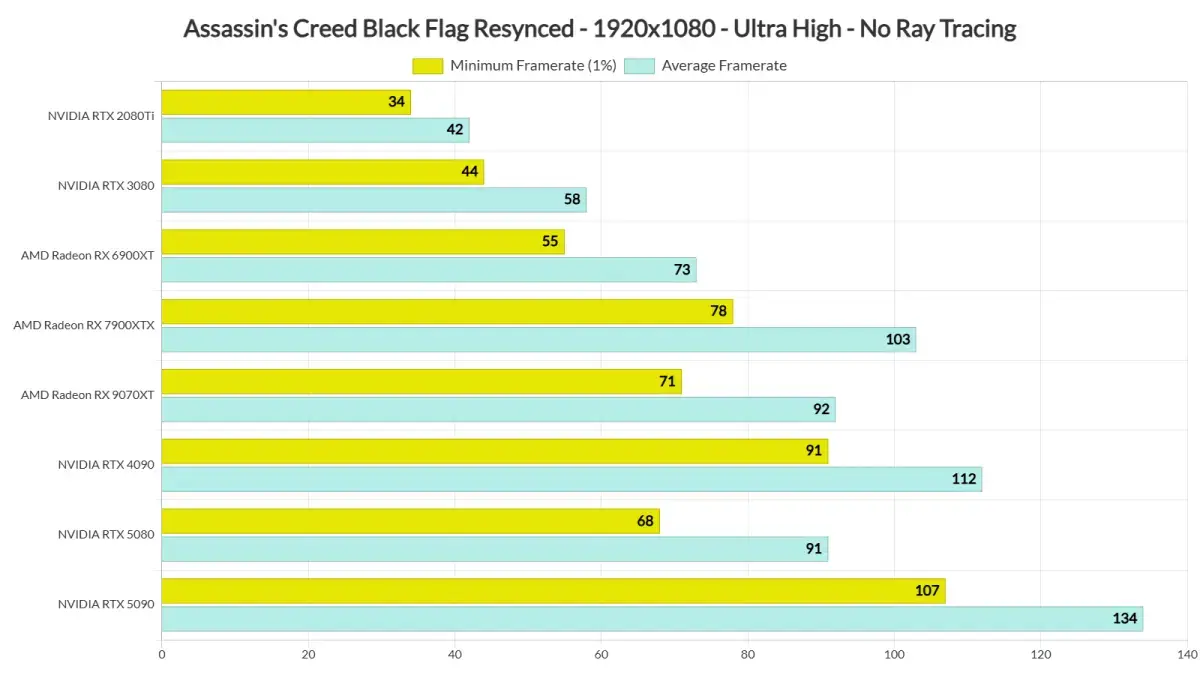
At 1080p resolution with Ultra High settings and ray tracing off, the picture is quite comfortable. The five most powerful cards tested manage to stay above 60 FPS in all conditions. Even the AMD Radeon RX 6900XT can deliver a smooth experience when used with a FreeSync-supported monitor. This is good news for players with a card that is a few generations old but still solid; because 1080p is still the resolution preferred by the majority of PC gamers.
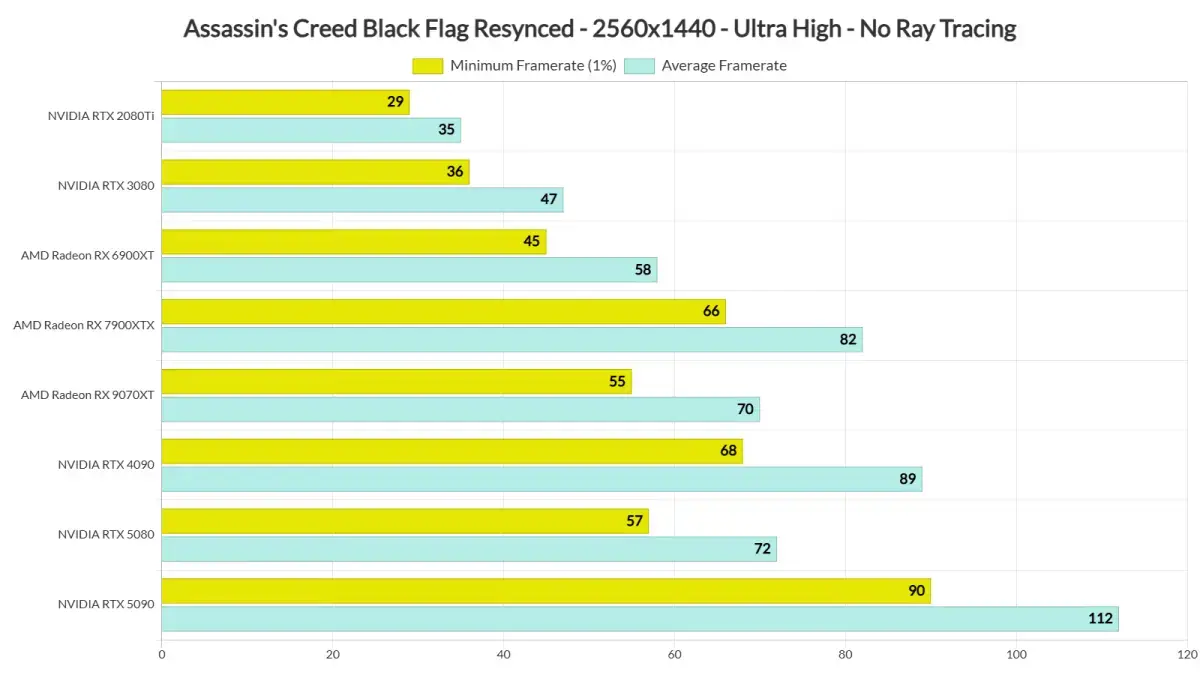
When you go up to 1440p, the game starts to demand noticeably more GPU power. At this resolution, the AMD Radeon RX 9070XT and NVIDIA RTX 5080 can occasionally drop below 60 FPS. Still, if you have a G-Sync or FreeSync supported monitor, these drops can be absorbed without spoiling the gaming feel. On the other hand, the RX 7900XTX, RTX 4090, and RTX 5090 manage to keep the frame rate constantly above 60 at 1440p. The practical lesson here is: at 1440p, variable refresh rate technology becomes a comfort factor as important as the frame rate itself.
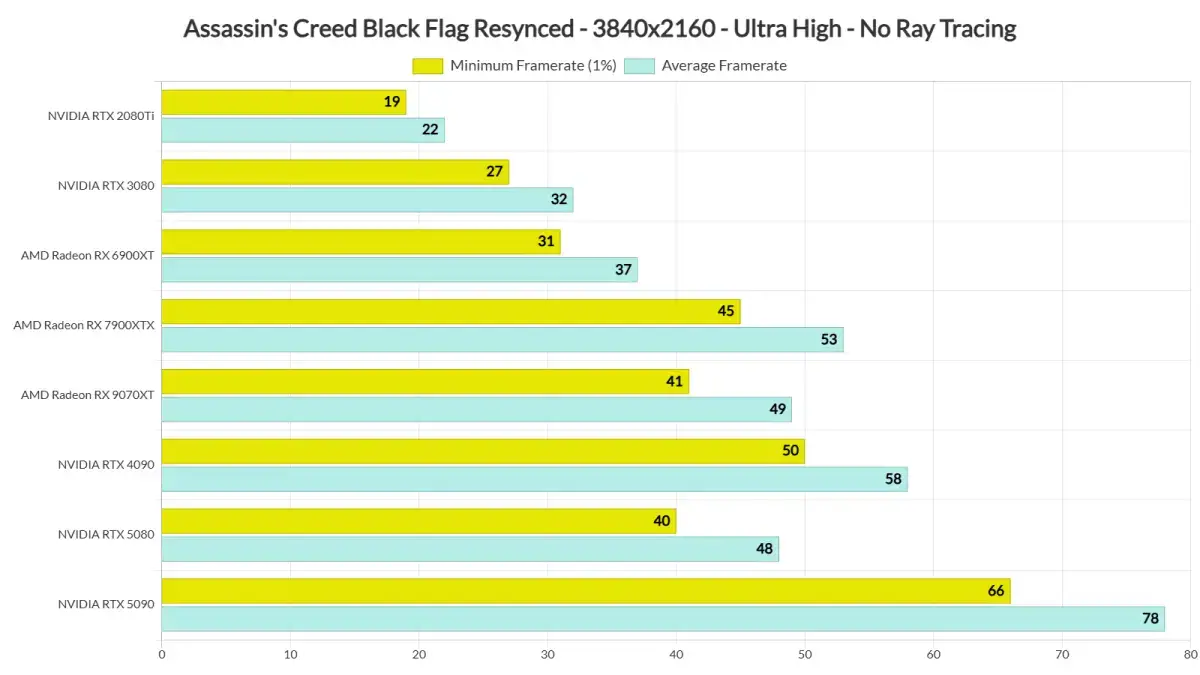
At native 4K and Ultra High settings with ray tracing off, the card clearly required is the NVIDIA RTX 5090. The good news is that the game, unlike Assassin's Creed Shadows, can run above 60 FPS in all conditions with this card. The bad news is that the second most powerful card, the RTX 4090, cannot deliver a 60 FPS experience at 4K. This alone shows how sharp the generational difference is in this game. So if you have a 4K monitor and aim for high frame rates, setting off without using an upscaler is not realistic.
AMD or NVIDIA? The game's card preference is clear
Just like in previous Assassin's Creed games, Black Flag Resynced seems to favor AMD hardware more. At 1080p Ultra High settings, the AMD Radeon RX 7900XTX and RX 9070XT can surpass the NVIDIA RTX 4090. Similarly, the RX 6900XT leaves the RTX 3080 behind. Such brand tendencies usually stem from the game engine fitting better with a certain architecture and can be balanced over time with driver updates.
The game's general character exhibits a largely GPU-bound structure. At 1080p Ultra High settings, the RTX 5090 runs at almost full capacity — but only "almost." In some scenes, GPU usage has been observed to drop to 85% without any visible reason, and there is no CPU bottleneck in these scenes. This points to an efficiency issue that needs to be resolved on the driver side and is expected to be improved in future NVIDIA drivers. From the user's perspective, this means that some of the card's potential is left on the table for now.
The difference between presets is smaller than expected
Unfortunately, the preset graphics settings offered by the game do not provide large performance jumps. The gain between the two highest setting tiers remains quite small; this means the top setting adds very little visually while seriously taking away from performance. In this picture, the most balanced option stands out as the High setting; it offers a reasonable middle ground between visuals and frame rate.
More interesting is that Medium and Low settings give almost the same performance. Although Medium looks noticeably better than Low, there is no serious difference in frame rate; the reason for this cannot be clearly explained. Very Low and Ultra Low settings, on the other hand, provide a noticeable performance increase, but the cost is large compromises in visual quality. The practical recommendation is: instead of trying the intermediate tiers one by one, directly using High as a base and manually lowering a few settings on top of it may be a more efficient way.
Visual quality and comparison with Assassin's Creed Shadows
On the visual side, Black Flag Resynced lags one step behind the impression left by Assassin's Creed Shadows. The game still looks impressive; however, the "wow" effect felt while playing Shadows is not at the same intensity here. Lighting and ray-traced global illumination are also not as advanced as in Shadows. Forest areas, on the other hand, stand one or two notches below compared to Shadows.
Probably this very difference is behind the game running better than Shadows. Ubisoft seems to have established a conscious balance between visuals and performance, and this balance works in terms of playability. However, this choice has a cost: a production that lags behind the previous game visually runs more comfortably technically. The main expectation here is that the next game can combine Shadows-level visuals with the performance comfort of Black Flag Resynced.
No stutters, but a few technical hitches
One of the most striking findings of this review is how clean the game is regarding stutter. During 4-5 hours of gameplay, not a single stutter was experienced; this is a quite rare occurrence in today's PC games. Although a few stutters were seen in the benchmark tool with ray tracing on, the experience remains completely smooth in actual gameplay. This is a serious plus point, especially in an era where shader compilation-induced stutters are common.
Controls are also problem-free: there are no known issues from mouse acceleration or smoothing. Still, the game is not flawless. It is reported that there is a bug that locks to 30 FPS in cinematic scenes; this can spoil the smoothness during storytelling. Also, the game seems to use Preset E by default for DLSS 4.5 — although it can be forced to Preset M via the NVIDIA App, the fact that this setting does not come automatically forces the user to intervene manually. Occasionally, strange errors in animations have also been observed.
What do these results mean for the player?
Looking at the overall picture, Black Flag Resynced offers a truly polished version at launch. It is not flawless, but it is definitely in a better place than Assassin's Creed Shadows was on its release day. The game looks good and runs well on a reasonable range of hardware; productions that achieve both at the same time have been in the minority in recent years. Ray-traced effects, while not transforming the game from top to bottom, come with a small performance cost and are pleasing to have.
Practical recommendations can be listed as follows: at 1080p, if you have a mid-to-high-end card, you are comfortable; at 1440p, a monitor with variable refresh rate support makes a big difference; at 4K, expecting high frame rates without the most powerful cards and upscaler support is not realistic. In settings, the High tier is the most efficient starting point for most systems. In summary, this production can easily be considered a well-optimized launch on PC — Ubisoft seems to have finished the job this time without annoying the player.