
Playing ranked in League of Legends is a completely different experience from the rest of the game: from matchmaking to which friends you can queue with, many things depend on the rules of this system. In the 2026 season, Riot made significant adjustments to rank distribution and matchmaking to more accurately reflect players' true skill levels. In this guide, you'll find the full order of ranks from bottom to top, the player distribution as of August 2026, how MMR works, and why LP decays on its own at high ranks. Whether you're stuck in Bronze or have hit a wall in Diamond, understanding how the system works directly affects your climb.
MMR: The invisible engine behind your rank
There's a number you never see on screen but that governs the entire game: MMR (Matchmaking Rating). This value is calculated from matches you win and lose, as well as your in-game performance, and it places you in the same queue as players with similar MMR. So a win raises not only your LP but also the hidden score behind it; losses do the opposite. While your visible rank is the label everyone reads on your profile, MMR is the engine of matchmaking — and the two don't always move at the same speed.
That's why MMR remains one of the most debated topics in League of Legends. Many players believe they're being treated unfairly, constantly matched with bad teams, or placed in a supposed "loser's queue." Riot's 2026 distribution changes target exactly this perception: the goal is for a player's true skill to be reflected more clearly in their visible rank. The company's MMR and rank distribution developer blog clearly lays out the reasoning behind this approach and the intended balance.
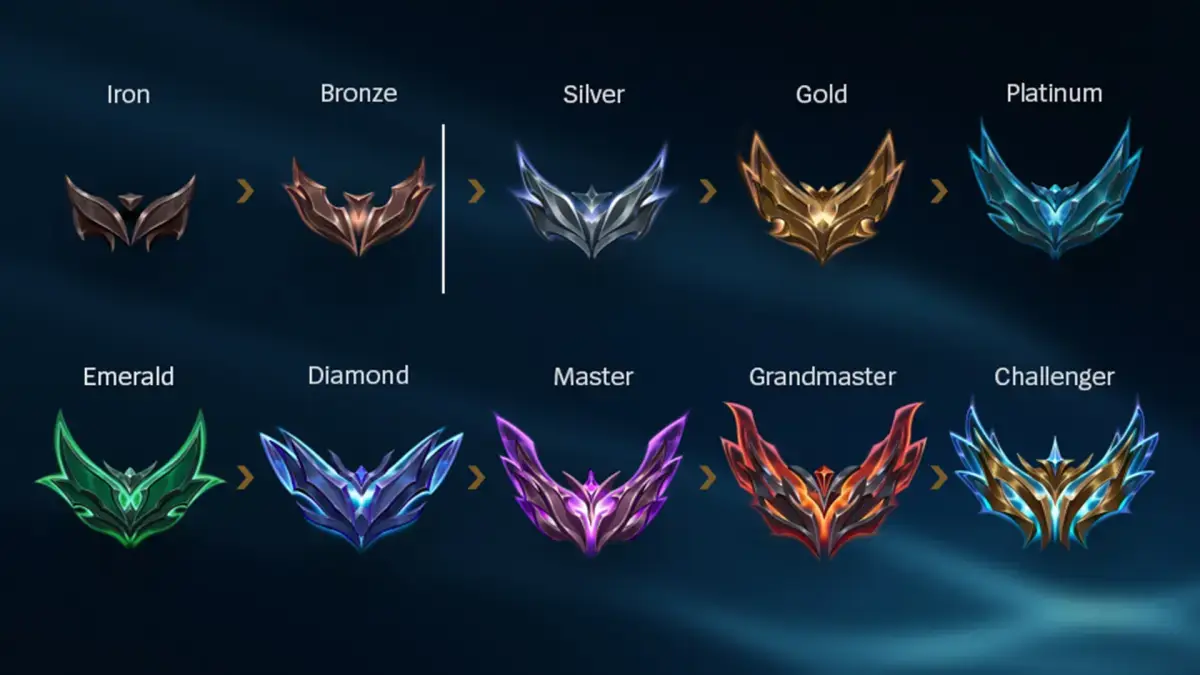
From Iron to Challenger: The full order of ranks
League of Legends has ten ranks in total, and the list starts at the bottom with Iron and ends at the top with Challenger. Master, Grandmaster, and Challenger form a separate group: the "Apex" ranks. These three tiers are completely outside the division system reserved for the game's best players. The ranks from Iron to Diamond, however, are divided into four divisions each; that means to go from Platinum to Emerald, you first need to climb from Platinum IV to Platinum I. The table below shows the order of ranks, division structure, and duo queue restrictions together.
| Rank | Divisions | Duo queue restriction |
|---|---|---|
| Iron | IV – I (four divisions) | Iron – Silver |
| Bronze | IV – I (four divisions) | Iron – Silver |
| Silver | IV – I (four divisions) | Iron – Gold |
| Gold | IV – I (four divisions) | Silver – Platinum |
| Platinum | IV – I (four divisions) | Gold – Emerald |
| Emerald | IV – I (four divisions) | Platinum – Diamond III |
| Diamond | IV – I (four divisions) | For Diamond IV–II: Emerald II – Diamond II / For Diamond I: Diamond III – Master |
| Master | No divisions | Diamond I – Grandmaster |
| Grandmaster | No divisions | Master – Challenger |
| Challenger | No divisions | Grandmaster – Challenger |
The duo column in the table shows how tiered the system's logic is. At lower ranks, queueing with a friend is quite flexible; a Silver player can duo with anyone from Iron to Gold. As you climb, this range narrows, and in Diamond's upper divisions the rules become much stricter. Once you reach the Apex ranks, the matchmaking pool shrinks so much that duo restrictions are almost limited to your immediate league neighbors.
Lower ranks: Iron, Bronze, Silver, and Gold
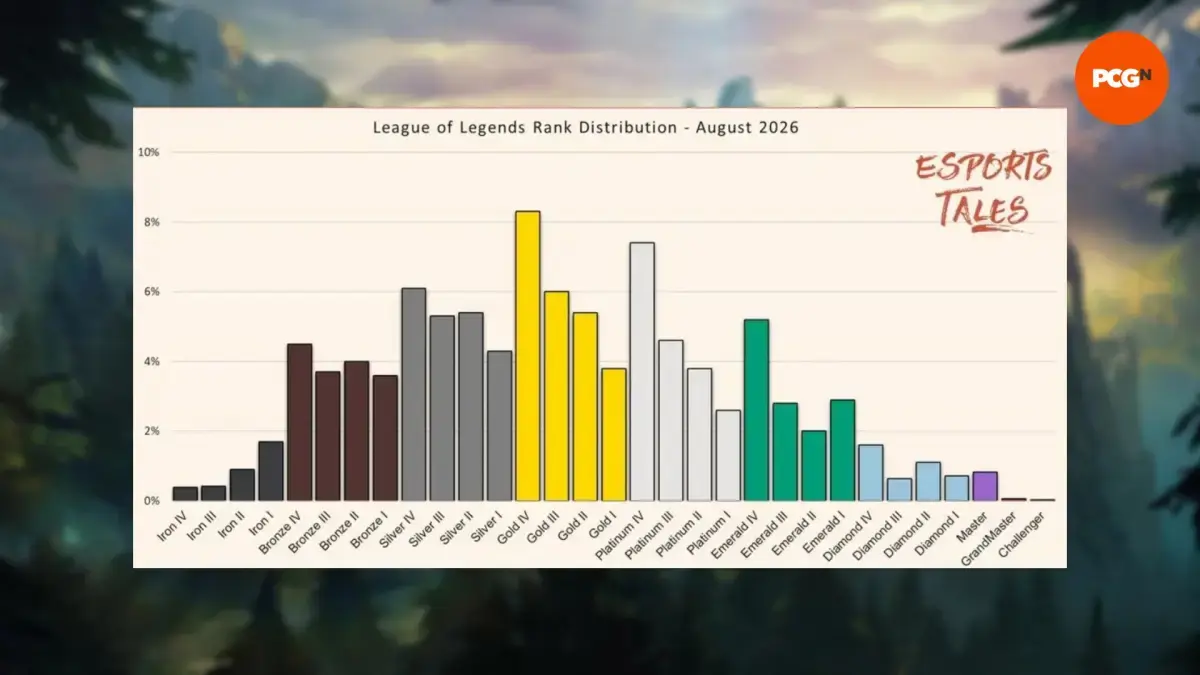
At the bottom of the ladder is Iron, and according to 2026 data, only 3.4% of players are in this rank. Iron players can duo queue with anyone between Iron and Silver, which means a way out with friends' support for newcomers. Bronze, just above it, contains 16% of players, and its duo restriction is the same as Iron's: the Iron – Silver range.
Silver is a crowded rank, making up 21% of the distribution, and its duo range extends from Iron to Gold. The most crowded tier on the list is Gold at 24%: nearly a quarter of players compete in this rank. Gold players can duo with accounts between Silver and Platinum. These four ranks represent the steepest part of the game's learning curve; most players stuck here are actually lacking in decision-making and map awareness more than mechanics. It's no coincidence that the distribution is concentrated so heavily in the lower area: the consistency required to climb demands far more than a single good match.

Middle and upper tiers: Platinum, Emerald, and Diamond
Platinum contains 18% of players and can duo with opponents between Gold and Emerald. This rank can be thought of as the starting point for players who have learned the game at a basic level. Emerald, just above it, forms the upper limit of the middle tier with a 13% share; its duo range extends from Platinum to Diamond III. Because Emerald is one of Riot's relatively new ranks, the player profile there is still frequently discussed.
Diamond is the threshold where things get serious: only 4% of players reach this rank. Diamond's duo rules are much more complicated than the others; players between Diamond IV and Diamond II can duo with accounts from Emerald II to Diamond II, while those who reach Diamond I can duo with accounts between Diamond III and Master. This complexity can be read as a measure to protect the matchmaking pool at higher ranks. In short, Diamond is a true threshold rank in terms of both skill and system rules.
Apex ranks: Master, Grandmaster, and Challenger
The common feature of Master, Grandmaster, and Challenger is that they aren't divided into divisions: there's no intermediate step like "Master II" here, you're directly in the rank itself. Master players can duo with accounts between Diamond I and Grandmaster. Grandmaster can only match within the range from Master to Challenger, while Challenger is limited to the Grandmaster – Challenger range.
The population of these ranks is a story in itself: only 0.83% of players are in Master, 0.054% in Grandmaster, and just 0.023% in Challenger. So climbing to the very top of a pool of hundreds of thousands out of thousands of players requires both consistent performance and a serious time investment. Since the matchmaking pool shrinks at Apex ranks, it's also quite normal to run into the same names frequently.
August 2026 rank distribution: Where does the game get crowded?
The table below shows the August 2026 distribution based on Esports Tales data. When you look at the percentages, you'll immediately notice that the table is weighted toward the bottom: the vast majority of the player base is concentrated in the Silver, Gold, and Platinum range.
| Rank | Player percentage |
|---|---|
| Iron | 3.4% |
| Bronze | 16% |
| Silver | 21% |
| Gold | 24% |
| Platinum | 18% |
| Emerald | 13% |
| Diamond | 4% |
| Master | 0.83% |
| Grandmaster | 0.054% |
| Challenger | 0.023% |
Traditionally, the distribution always followed a curve weighted toward the bottom, but entering 2026, Riot acknowledged that previous versions of the system didn't fully reflect the skill of the modern player base. The adjustments made as a result ensured that a player's true rank was represented more accurately, and more players settled into the Silver, Gold, and Platinum range. This change means two things, especially for players in the middle tier: on one hand, your rank better reflects your skill; on the other, the opponents you face at the same rank are now, on average, more competent.
The most striking part of the distribution is how small a minority the upper ranks cover. Master, Grandmaster, and Challenger combined remain below 1%. This table is actually also the answer to the question "Why is it so hard to reach Diamond?": because Diamond alone includes only 4% of players.
LP, promotion, and rank decay
Every win in ranked matches earns you LP; when you reach 100 LP, you're promoted to the next rank or division. This threshold changes at high ranks: in Grandmaster you need to reach 400 LP, and in Challenger, 800 LP. Matches you lose reduce your LP and can demote you by the same logic. At Apex ranks, however, things change, because if you don't play, you start losing LP.
Rank decay kicks in at Diamond, Master, Grandmaster, and Challenger. You don't have to play every day; you're given accumulated days called "banked days." When these run out, you lose a certain amount of LP each day. The table below summarizes how many days you can bank at which rank and how much LP you lose once decay begins.
| Rule | Diamond | Master, Grandmaster, Challenger |
|---|---|---|
| Days banked per match | 7 banked days | 1 banked day |
| Maximum banked days | 28 days | 14 days |
| Time before decay begins | 28 days | 14 days |
| LP lost | 50 LP | 75 LP |
This table may look harsh at first glance, but it's worth remembering the LP ceiling of the two ranks: in Grandmaster you have a 400 LP buffer, and in Challenger, 800 LP, so decay leaves some room for maneuver in your pocket. Still, quitting play at Apex ranks can quickly turn into rank loss. This mechanic was designed to prevent high-rank account owners from "camping" their position and to keep the matchmaking pool active.
Autofill, Aegis of Valor, and dodge penalties
In 2026, an important change also came to LP rules affecting victims of autofill. Riot introduced a protection called "Aegis of Valor" for players who are autofilled: when you leave a match with a grade of C or higher, you either earn double LP for a win or are fully protected against LP loss in a defeat. This incentive was introduced because fill roles play a role in keeping queue times manageable; in other words, the system aims to share this burden by rewarding players who play a role they didn't want.
In the same period, stricter penalties were introduced for dodging. Now, dodging a match counts as a full loss, plus the usual queue cooldown penalty is added. This change is aimed especially at preventing players who constantly dodge for "bad match" reasons from destabilizing queue stability. In practice, this means you should think twice before pressing the dodge button.
Could a new rank below Iron be added?
In Riot's March 2, 2026 developer blog, lead game designer Matt "Phroxzon" Leung-Harrison states that they've "seen great success" with the changes. However, according to the explanation, this improvement wasn't enough at the lower end of the system; distinguishing between lower skill levels is still difficult. Therefore, Leung-Harrison says that in the future, "a completely new rank below Iron may be needed." In other words, adding another rank below the game's lowest tier is one of the possibilities on the table.
If such a change goes live, the picture could change significantly for players in lower ranks: the rank order shifts down a step, distribution percentages are recalculated, and some current Iron players could be placed in the new lowest rank. Riot's developer blog on MMR and rank distribution is a good starting point for those who want to see the data approach behind such structural discussions.
Conclusion: What does this picture mean for you?
To summarize: League of Legends has ten ranks, those from Iron to Diamond are divided into four divisions, and Master and above form the divisionless Apex ranks. The center of the distribution is Silver, Gold, and Platinum; the Apex ranks cover less than 1% of players. Behind your visible rank, MMR is working, and especially above Diamond, stopping play directly means losing LP. If you want to climb, the first step is to understand not what rank you're in, but what rank you should be in: tracking where MMR is taking you and maintaining consistent match performance is far more effective than one-off lucky wins. In the coming seasons, adding a rank below Iron or continuing distribution adjustments may come up; so it's worth keeping an eye on both rank thresholds and LP rules.