
When evaluating a newly released PC game, the first question is no longer "How do the graphics look?" but "How does it run on which system?" Resonance: A Plague Tale Legacy, published by Focus Entertainment and running on Asobo Studio's own game engine, gives an unexpectedly positive answer to this question. The game has been released on PC, and the measurements show that it offers a comfortable experience across a wide range of graphics cards, from mid-range to high-end. In this article, we examine what the game delivers on which hardware, what is available in the settings menu, and what costs this comfortable performance has on the visual quality side.
To summarize briefly: This new title bearing the A Plague Tale name stands out technically as one of the year's most "trouble-free" PC releases. There are no day-one stutters, no memory issues, and no optimization weakness that wastes hardware. However, the interesting part is that this excellent performance goes hand in hand with certain compromises in visual technologies. Below, we will examine this resolution by resolution and setting by setting.
Optimization Has Become a Privilege
Recently, the most common complaint among PC players is that new games are unplayable on release day. Titles adorned with heavy global illumination, massive texture packs, and cinematic effects arrive with both very high system requirements and low frame rates at the same time. In this environment, a game running smoothly at launch has become almost an exception. Therefore, a well-optimized PC version is now a more valuable marketing tool than the game's own advertisement.
Resonance: A Plague Tale Legacy makes a difference exactly at this point. The game's PC performance follows the exact opposite of the "fixed later with a patch" scenario that players have grown accustomed to in recent years. Asobo Studio's use of its own engine appears to be the most critical factor here: instead of the extra overhead and compatibility issues brought by an off-the-shelf third-party engine, the team's mastery of its own tools has turned into an advantage. Of course, there is a trade-off; we will discuss that in the visual quality section.
Test System and Measurement Conditions
The published measurements used an AMD Ryzen 9 7950X3D processor, 32 GB of DDR5 memory running at 6000 MHz, and the Windows 10 64-bit operating system. On the graphics card side, there is a wide range of both older and newer generations. The tested cards are listed as follows:
- AMD Radeon RX 6900XT, RX 7900XTX, and RX 9070XT
- NVIDIA GeForce RTX 2080Ti, RTX 3080, RTX 4090, RTX 5080, and RTX 5090
The drivers used are stated as GeForce 610.88 and Radeon Adrenalin Edition 26.7.1. This card list actually summarizes the game's claim on its own: a card like the RTX 2080Ti, which can now be considered "old," and a flagship card like the RTX 5090 appear in the same test table. This shows that performance is meaningful not only in the top segment but across a wide hardware range.
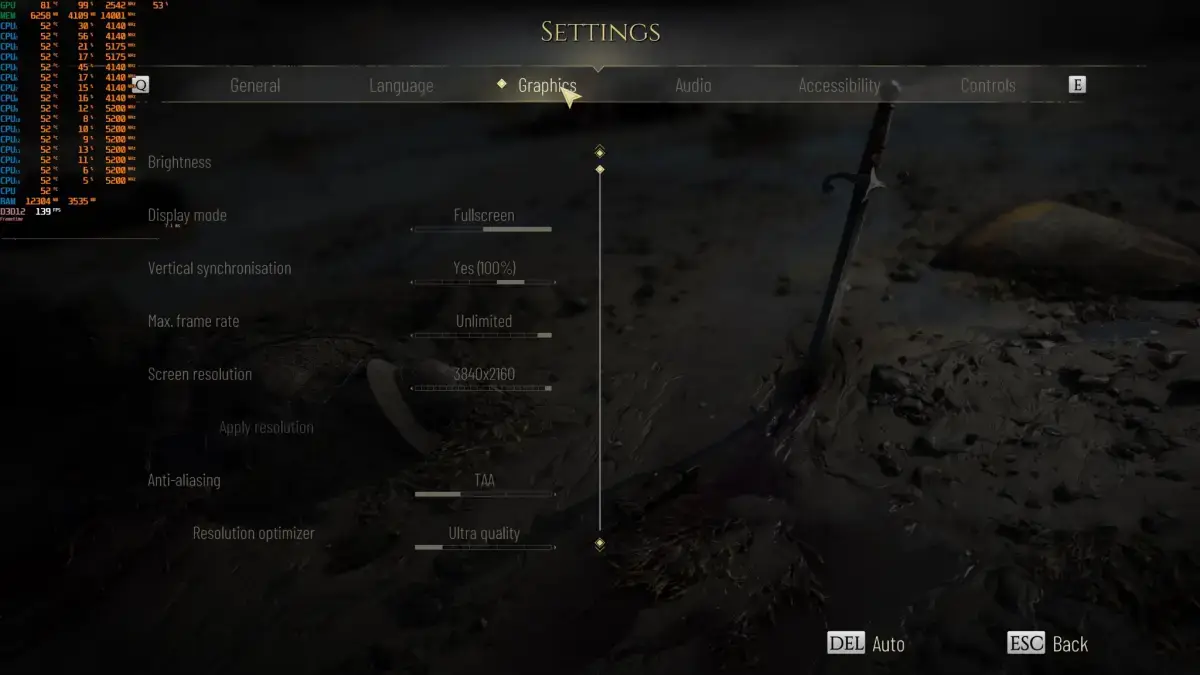
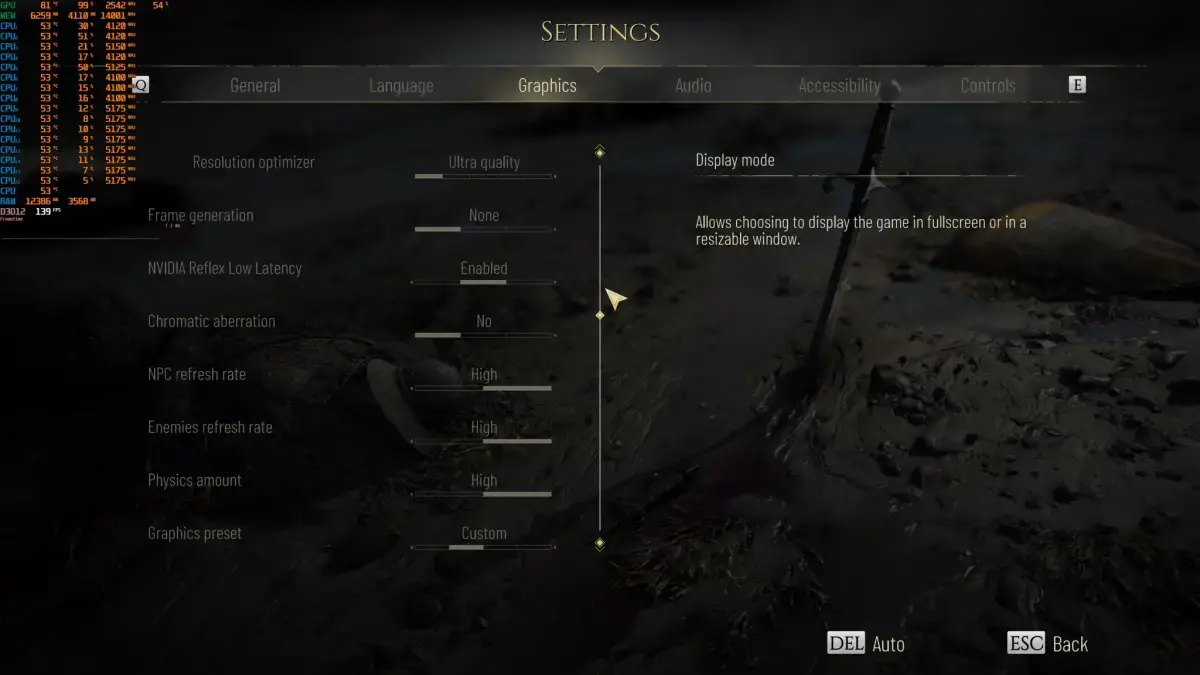
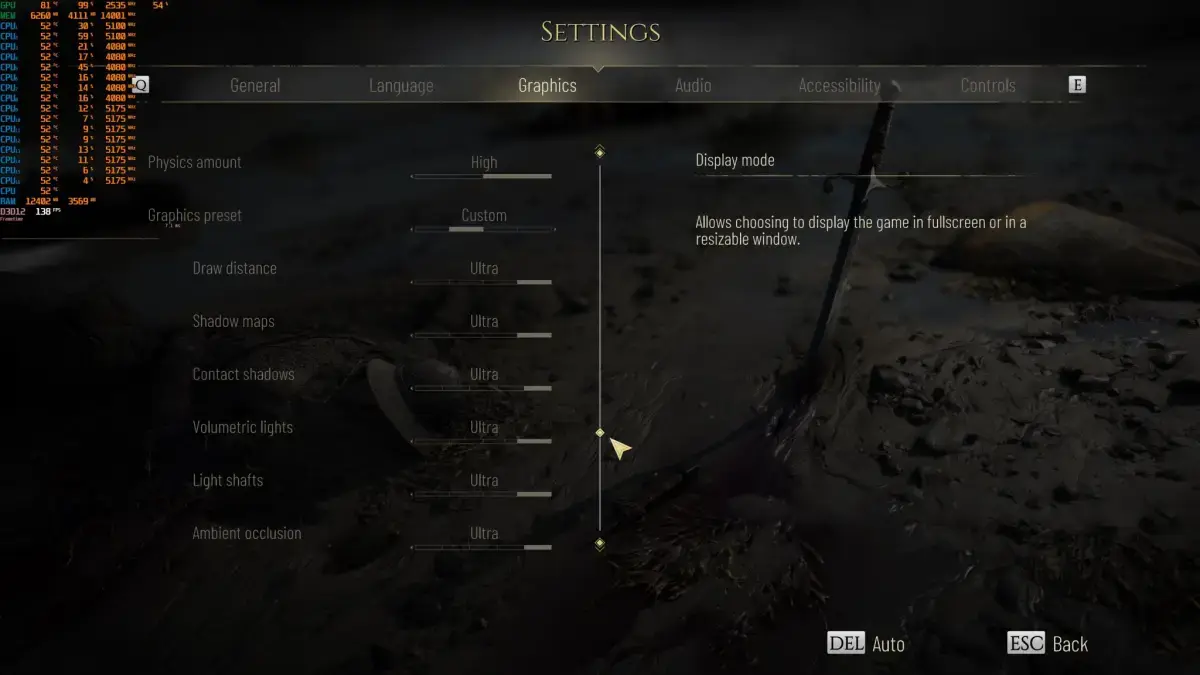
On the settings menu side, the player is given serious control. The quality of textures, shadows, volumetric lights, draw distance, and ambient occlusion can be adjusted separately. The game is also generous with upscaling technologies: both AMD FSR 3.0 and NVIDIA DLSS 4 with Multi-Frame Generation are supported. However, Intel XeSS support is once again missing; this should be noted as a recurring disappointment for Intel Arc users.
There is a notable detail in the measurement methodology: The game does not have a built-in benchmark tool. Therefore, the tests were carried out in a single scene from one of the early chapters of the game that stresses both the processor and the graphics card. Measuring in such a fixed scene makes sense for reproducibility of results; but it should also be kept in mind that the entire game does not produce the same load.
1080p and 1440p: The Limit Set by the Processor
At 1080p resolution and maximum settings, an interesting picture emerges: The system is now limited by the processor, not the graphics card. In other words, at this resolution, most graphics cards cannot use their full potential because the workload bottlenecks at the processor. Nevertheless, the result is extremely positive; all tested cards offer a smooth experience.
In fact, even a relatively old card like the RTX 2080Ti provides a smooth experience in this list; the only condition is using a G-Sync compatible monitor to hide screen tearing. When we move up to 1440p, the picture changes slightly. The vast majority of cards stay above 60 FPS at all times; the only cards that fall below this threshold are the RTX 2080Ti and Radeon RX 6900XT. However, when a FreeSync monitor comes into play, the RX 6900XT can also offer a smooth experience. The lesson to be drawn from this is: if you have an older card, a monitor with variable refresh rate support makes nearly as much difference in this game as a hardware upgrade.
No Need for High-End Hardware at 4K
The game's real surprise emerges at native 4K resolution and maximum settings. Under these conditions, the five most powerful graphics cards manage to deliver a smooth experience. The Radeon RX 9070XT can occasionally drop to 58 FPS; but even in this case, smoothness can be maintained with a FreeSync-supported monitor. In other words, small fluctuations in frame rate do not turn into noticeable stutter thanks to variable refresh rate.
The most striking result here is this: You do not need a flagship card like the RTX 5090 to play at 4K. It must be noted that a game running this comfortably at native 4K has not been seen for a long time. This is proof that optimization is still possible; and without leaning on upscaling technologies. The development team thoroughly deserves a well-earned congratulations at this point.
Inconsistency in Visual Quality: The Cost of Lighting
While the performance side is this good, the visual side can fall below expectations. The game's first region does not look as impressive as the desert region that comes later. Behind this is a technical choice: Asobo Studio used baked lighting, and there are no ray tracing effects in the game. This choice directly improves performance, but the results can be uneven in places.
By its nature, baked lighting relies on precomputed static data for how light behaves; it cannot react to dynamic changes. Therefore, while lighting looks truly magnificent in some scenes, in others it feels a few generations behind, even somewhat dated. This creates an inconsistency in the game's overall visual identity; as the player moves from one region to another, the perception of quality can change suddenly.
Still, we should not be unfair: Resonance: A Plague Tale Legacy is not a bad-looking game. Character models are extremely detailed, and some environments are truly impressive. The issue is that the game carries the visual limitations common to all rasterization-based titles. In other words, the criticism here is not directed at the game's lack of care, but at the natural limit of the chosen technology. It is clear that it is not one of the best-looking games of 2026; but it is not one of the worst-looking either.
No Stuttering, Controls Are Spot On
One of the issues often overlooked in performance reviews but most affecting the player's experience is frame rate stability. Resonance: A Plague Tale Legacy opens a clean slate in this regard: No serious stuttering issues were experienced during testing. The game ran smoothly without major interruptions. Those annoying pauses that occur during large asset loads or scene transitions do not show themselves here.
Mouse movements also respond as expected; in other words, there is no sense of delay or sluggishness in camera control. The display of correct key prompts on screen for keyboard and mouse is a small but important detail. While many PC versions still continue to show console buttons on screen, here the player does not need to think about which key to press. Although these may seem like small details individually, when taken together they give the feeling that "this version has really been overhauled for PC".
Conclusion: What Does This Mean?
Resonance: A Plague Tale Legacy offers a rare comfort for PC players. It runs smoothly across a wide range of graphics cards, does not require a high-budget system even at 4K, and does not struggle with stuttering issues. Even players with an older card can easily enjoy the game if they have a monitor with variable refresh rate support. This is refreshing news, especially for players who have been disappointed by system requirements in recent years.
On the other hand, this comfort has a cost: The game chose a conservative path in visual technologies. There is no ray tracing, lighting is baked, and as a result, visual quality varies from region to region. So the choice is clear: high frame rate and broad hardware compatibility, or cinematic visual spectacle? Asobo Studio chose the first option and applied it consistently. It will be interesting to watch how developers strike this balance in the coming period; because this game proves that good optimization is still not a marketing slogan, but a matter of technical choice.