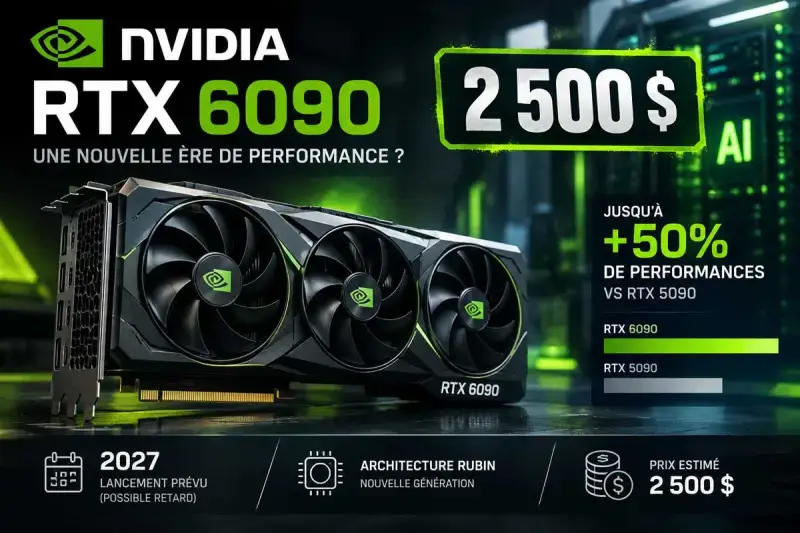
NVIDIA's flagship graphics cards become one of the most talked-about topics of every period, regardless of the announcement schedule. Now, a model that has not yet hit the market is being discussed: the GeForce RTX 6090. Two claims stand out: it is said that the card could go on sale at a price of around $2,500 and could offer up to a 50% performance increase compared to the current RTX 5090. When these two figures appear in the same sentence, a picture emerges that is both tempting and unsettling for high-end gamers. Because for the past few generations, we have seen that in flagship cards, price has moved upward along with performance. Below, we take up in turn what the rumor says, what justifications these figures are based on, and what they mean for gamers.
The source of the rumor and the claims put forward
The first serious leaks about next-generation GeForce cards came via the YouTube channel Moore's Law Is Dead, which the hardware world follows closely. According to the channel, the RTX 60 series will be based on the Rubin architecture, and the first model to be introduced will again be the most powerful version, namely the RTX 6090. This is actually consistent with the strategy NVIDIA has followed for years: first the flagship is introduced, and lower models arrive gradually afterward. Among the claims are that the card could be offered for sale at a price level of $2,500 and could deliver up to 50% higher performance compared to the RTX 5090. However, it must be underlined here: none of this information has been confirmed by NVIDIA, and there is no statement to that effect on the company's official channels. So right now we have figures that rumor has built on top of rumor; not a finalized product specification.
It is worth remembering how such leaks function in the hardware world. Usually, the first information about a next generation begins with fragmented data leaking from sources in the production chain; then these pieces are combined to form a picture. During this process, some details turn out consistent, while others may not match the final product at all. Therefore, the healthiest way to read the discussions around the RTX 6090 is not as "a fact that will soon be confirmed" but as "the scenario most talked about right now." After all, the phrase "up to 50%" in the claims also indicates an upper limit; that is, the most optimistic scenario.

Why is the 50% jump drawing so much attention?
What makes the performance claim meaningful is not the number by itself, but how this number compares with past generation transitions. A large part of the user community regarded the move from RTX 3090 to RTX 4090 as a true generational leap. In contrast, the move from RTX 4090 to RTX 5090, while varying by use case, was generally found more modest, with a gain of around 30%. If the 50% increase discussed for the RTX 6090 materializes, NVIDIA will have returned to the feeling of a "big leap" that gamers have long been waiting for.
Of course, such percentages do not always mean the same thing. A card's gaming performance can vary significantly depending on resolution, the ray tracing settings used, whether upscaling technologies are active, and the engine of the game being tested. A 50% difference: is it achieved in pure raster performance, in heavy ray tracing scenarios, or in AI-assisted frame generation? That needs to be clarified. Therefore, treating the figure for now as a "potential upper limit" is a more realistic approach in order not to be disappointed. Still, the fact that the first leaks start at such an ambitious level suggests that the Rubin architecture may bring a significant architectural revision.
Why doesn't the $2,500 price tag surprise anyone?
Hearing $2,500 for a graphics card may seem exaggerated at first glance, but when you look at how the high-end segment has moved in recent years, this figure is not surprising. Flagship card prices have risen steadily over generations, and today top-model cards with the most special cooling designs from partner manufacturers are already approaching similar levels. So $2,500 is not a fantasy disconnected from the market's current reality; it looks like the next step in the existing trend.
There are several structural reasons behind this rise. Production costs increase with every generation; more advanced lithography processes, larger chip areas, and more complex cooling solutions are directly reflected in price. What is more critical is that competition is happening within itself: AI accelerators carry much higher margins than cards aimed at gamers. This naturally leads NVIDIA to shift its production capacity and engineering priorities toward the data center side. This shift in the company's priorities directly affects the price and supply dynamics of cards aimed at gamers.
For those who want to read the picture specifically for Turkey, there is another layer. Official prices in dollars can be reflected on retail shelves as much higher figures due to exchange rate fluctuations, import taxes, and distributor profits. Therefore, a $2,500 level discussed abroad can mean a completely different budget in the local market. This is why it is important for users planning an upgrade to decide not according to rumors but according to their own budget and needs.

The timeline question: 2027 or 2028?
The biggest uncertainty around the RTX 60 series concerns its release date more than price or performance. According to information reported by Moore's Law Is Dead, NVIDIA aims to bring the first RTX 60 models to market within 2027. It is stated that the company initially planned the middle of the year, but some factors could push the timeline back. At this point, the most discussed factor is capacity allocation in the most advanced production processes.
Because AI demand continues to grow without slowing, chip manufacturers prioritize the most advanced and most profitable products. In this situation, GPUs aimed at gamers cease to be an absolute priority for NVIDIA. Therefore, a timeline that slips to the end of 2027, or even the beginning of 2028, is not entirely illogical. On the other hand, competition stands out as the only serious lever that could accelerate the timeline. If AMD releases its high-end RDNA 5 cards within 2027, it is assessed that NVIDIA might want to move its move forward to maintain performance leadership.
The real issue here is what a date like 2028 means for gamers. For a user who has just bought their current card, a two-year waiting period is long enough to completely change the purchase decision. Moreover, postponing an upgrade according to a rumor-based timeline carries a serious risk, since there is no finalized product in sight. Therefore, the timeline discussion should be read less through the question "Should I wait?" and more through the question "Is there something concrete worth waiting for?"
Power consumption: the quiet but most critical uncertainty
The topic that is not discussed as much as performance and price, but that will most affect the user experience in the long run, is power consumption. In recent generations, the debates around the 12V-2x6 connector and cards exceeding the 600-watt limit brought this issue seriously to the agenda. Therefore, NVIDIA is expected to focus on efficiency in its next flagship rather than pushing raw consumption even higher.
If this expectation materializes, the resulting picture would be quite impressive. Offering 50% more performance with the same power consumption means not only achieving a higher number, but also less heat, quieter operation, and compatibility with the existing power supply. This makes the card accessible to a broad user base who do not want to build a new system but want to upgrade their graphics card. In the opposite scenario, that is, if performance is achieved by also raising consumption, users will need to take additional items such as case ventilation, power supply capacity, and electricity cost into account.
Considering the weight of electricity tariffs in household budgets in Turkey, this topic ceases to be merely a technical detail. A high-consumption flagship card creates a monthly expense item beyond the initial purchase cost. Therefore, an efficiency-focused generation can provide a double win in terms of both performance and total cost of ownership. In short, although the power consumption topic may seem boring, it is actually one of the elements determining the card's real value.
The AMD front: will competition pull prices down?
What determines where prices go in the high-end segment is not only NVIDIA; the course of competition is also decisive. The first rumors about the RDNA 5 architecture suggest that AMD's most powerful models could be positioned in the $1,500 to $2,500 range. If this range is correct, an area will have opened up that creates a price gap in the flagship segment. This raises the question of how comfortably NVIDIA can apply a $2,500 price tag.
The strategy AMD has followed recently strengthens this possibility. The Radeon RX 9000 series managed to attract more gamers than expected thanks to its aggressive pricing. In other words, AMD showed that even if it does not take performance leadership in the high-end segment, it can gain market share through price-performance balance. If this approach is maintained in the RDNA 5 generation, the high-end card market could once again become a real competitive arena. Increased competition creates price pressure in favor of users in the long run.
Of course, it is also not right to build one-sided optimism here. Flagship cards are the area where production capacity is scarcest and margins are highest. In an environment where demand is constantly higher than supply, it would not be realistic to expect competition to immediately pull prices down. A more likely scenario is that both manufacturers maintain premium positioning in the high-end segment, with competition felt more in the upper mid-range. Still, AMD's presence remains a balancing factor that prevents NVIDIA from acting completely freely in its pricing decisions.
How should gamers approach these rumors?
To summarize the current picture: we have an unverified price, an unverified performance figure, and an unclear timeline. In an environment where these three uncertainties exist at the same time, basing an upgrade decision on rumors is not healthy. For a user who can play the games they want at the settings they want with their current card, waiting may seem costless, but a date like late 2027 or 2028 is genuinely a long time. On the other hand, for a user experiencing a bottleneck in their current system—that is, unable to reach the desired resolution or frame rate because of their graphics card—it makes more sense to turn to today's options rather than wait two years.
A smarter approach is to use rumors not as a "buy signal" but as "preparation data." If the RTX 60 series really starts from the $2,500 band, this affects budget planning already. Likewise, the card's possible power consumption will determine the power supply and case choice in the next upgrade. Learning this information in time allows for a conscious choice instead of making a panic decision when the product comes out. In short, following the rumor is useful; committing based on it is premature.
What happens next?
It is almost certain that we will see more leaks about the RTX 60 series in the coming months. During this process, technical details such as chip sizes, memory configurations, and power consumption will probably also enter the discussion. Until an official statement comes from NVIDIA, all this information should be met with caution. Even the source itself presents the figures within a framework of estimation; it does not put forward a finalized product specification.
One thing is clear: the high-end GPU market is moving toward a new threshold. We are entering a period in which the habits of past generations will not apply on either the performance or the price side. The idea of a $2,500 flagship would have seemed exaggerated a few years ago; today it reads like a continuation of the existing trend. This shows that the real news is not price or performance, but where the industry's price perception has evolved. The next generation may cause gamers to ask the question "How much am I willing to pay?" again and from a higher level.