
In competitive Dota 2, there is only one concrete measure of progress: a rating that changes after every match and turns into a medal on your profile. Most players experience this system only as 'I won, it went up; I lost, it went down,' yet the mechanism working behind the scenes determines both whom you are matched with and how high you can climb in the long run. Understanding the ranks, thresholds, and climbing dynamics is not just a matter of curiosity; it is also the way to set the right expectations and avoid making the game unnecessarily stressful. In this guide, we cover the eight ranks, MMR thresholds, current distribution data, calibration logic, and climbing strategies from start to finish.
The difference between MMR and rank: number and medal
In Dota 2, MMR, or 'matchmaking rating,' is the numerical representation of your skill level and the primary data the system uses for matchmaking. Rank, or medal, is nothing more than the visual representation of that number; in other words, we are looking at two different presentations of the same reality. The most practical difference between them is this: MMR is visible only to you, while your medal is displayed on your profile for everyone to see, including players who are not on your friends list. That is why, for most players, the medal serves more as a social status marker than as a skill indicator.
MMR moves in every ranked match: it increases when you win, decreases when you lose, and this change directly affects your matchmaking pool. An important detail is that individual statistics do not directly determine this change. Whether you carry your team to victory with a score like 34-3 or win with a 1-12 game, the MMR you gain is calculated by the same logic; the system does not look at your kills, deaths, assists, or damage dealt. This is a deliberate design choice that breaks the 'I played well but my team was bad' feeling while also putting team play at the center. Nothing other than winning and losing directly affects your rating.
Grasping this distinction is critical for players who set out to chase medals. Since the medal is only a reflection, it is impossible to target the medal while ignoring MMR; the opposite, however, is entirely possible. So all you need to do is raise your rating, and the medal will follow. Accepting this simple truth also brings the answer to the question 'why am I still at the same medal': because your rating is still in the same place.
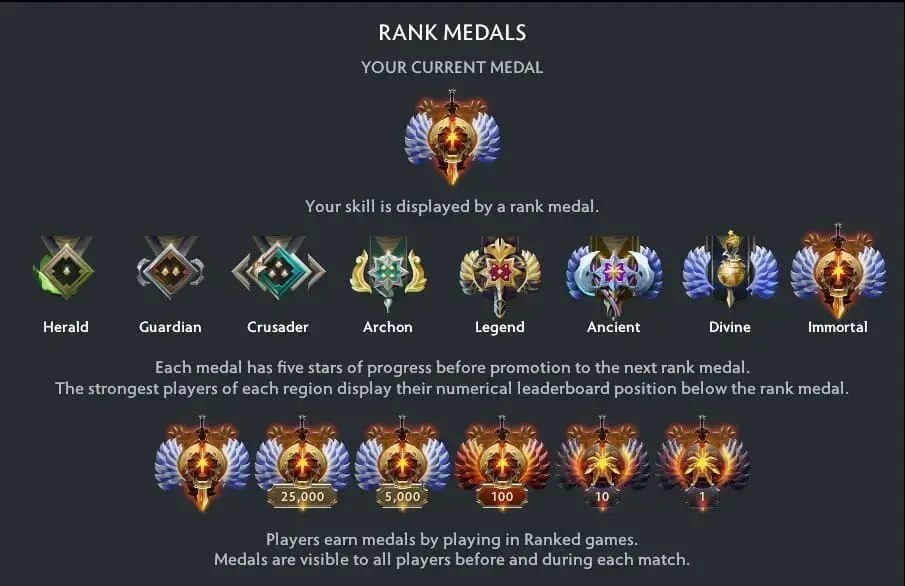
Eight ranks, thirty-six stars: the medal map
Dota 2 has a total of eight rank tiers, ordered from lowest to highest as follows: Herald, Guardian, Crusader, Archon, Legend, Ancient, Divine, and Immortal. These eight steps form a skill spectrum designed to cover the game's entire player base. Every tier except Immortal is divided into five stars or subdivisions indicated by Roman numerals: from I to V. To advance to the next tier, you must first complete all stars of your current tier.
To make this structure concrete, think of it this way: when you reach Archon V, the next stop is Legend I. From there, you continue climbing through Legend II, III, IV, and V. You can think of each star as a small checkpoint on your journey; on its own it means nothing, but when accumulated it carries you to the next tier. In total, it is a ladder made of seven tiers excluding Immortal times five stars, meaning thirty-five subdivisions plus Immortal.
The complete list of Dota 2 ranks from low to high:
- Herald I – V
- Guardian I – V
- Crusader I – V
- Archon I – V
- Legend I – V
- Ancient I – V
- Divine I – V
- Immortal
Players in the lower tiers are generally concentrated in the Herald, Guardian, and Crusader regions; the middle of the distribution sits around Archon. Ancient, Divine, and Immortal represent progressively smaller minority groups respectively. Keeping this picture in mind is important, because as you will see in the next sections, the distance between medals is not equal; some tiers are very close to each other, while between others there is a serious gap.
How much MMR is each rank? Threshold table
The question 'how much MMR do I need to reach that rank?' is one of the most frequently asked questions by ranked players. The estimated ranges below will make things easier by showing which score band each medal corresponds to. It is worth keeping in mind that the ranges are described as 'estimated,' because the system works with approximate bands rather than exact numbers. Still, seeing which tier corresponds to which level is more than enough for setting goals.
- Herald 1: 1–154 MMR
- Herald 2: 154–308 MMR
- Herald 3: 308–462 MMR
- Herald 4: 462–616 MMR
- Herald 5: 616–769 MMR
- Guardian 1: 770–924 MMR
- Guardian 2: 924–1078 MMR
- Guardian 3: 1078–1232 MMR
- Guardian 4: 1232–1386 MMR
- Guardian 5: 1386–1540 MMR
- Crusader 1: 1540–1694 MMR
- Crusader 2: 1694–1848 MMR
- Crusader 3: 1848–2002 MMR
- Crusader 4: 2002–2156 MMR
- Crusader 5: 2156–2310 MMR
- Archon 1: 2310–2464 MMR
- Archon 2: 2464–2618 MMR
- Archon 3: 2618–2772 MMR
- Archon 4: 2772–2926 MMR
- Archon 5: 2926–3080 MMR
- Legend 1: 3080–3234 MMR
- Legend 2: 3234–3388 MMR
- Legend 3: 3388–3542 MMR
- Legend 4: 3542–3696 MMR
- Legend 5: 3696–3850 MMR
- Ancient 1: 3850–4004 MMR
- Ancient 2: 4004–4158 MMR
- Ancient 3: 4158–4312 MMR
- Ancient 4: 4312–4466 MMR
- Ancient 5: 4466–4620 MMR
- Divine 1: 4620–4820 MMR
- Divine 2: 4820–5020 MMR
- Divine 3: 5020–5220 MMR
- Divine 4: 5220–5420 MMR
- Divine 5: 5420–5620 MMR
- Immortal: 5620 MMR and above
The most striking detail in this table is that up to the Ancient tier, each star is worth approximately 154 MMR. This means each medal corresponds to roughly 770 MMR in total. When you reach Divine, the pace slows somewhat; in this tier, each star is worth 200 MMR. To step into Immortal, you need to cross the 5,620 MMR band in total. In other words, the distance that must be covered from the very bottom of Herald to the gates of Immortal is not a negligible journey when you consider the average 25 MMR gained in a single match.
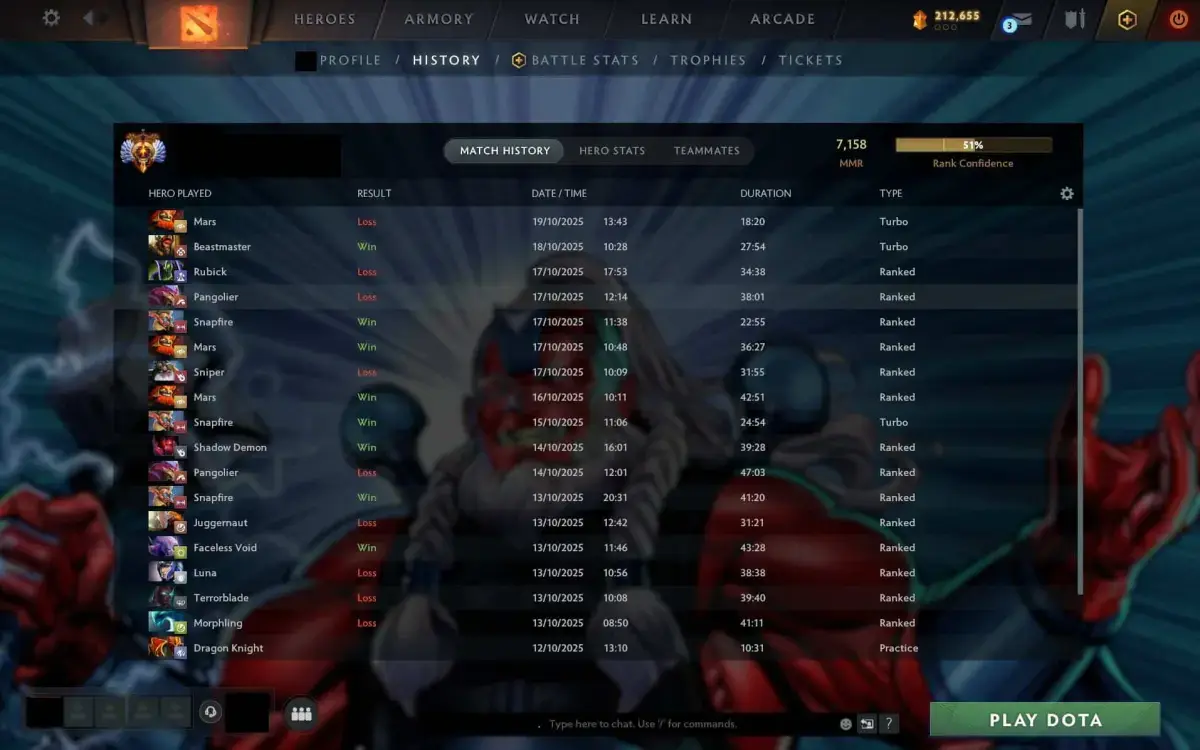
What do the Glicko-based system and Rank Confidence do?
To understand how MMR changes, two concepts need to be considered together: Glicko-based rating and Rank Confidence. Rank Confidence is a percentage showing the system's confidence in how accurately your MMR reflects your true skill level. On new accounts or accounts that have not been played for a long time, this confidence is naturally low; as the system gets to know you and collects match data, this rate rises. In short, Rank Confidence is a measure of how much information it has about you.
When you have a stable and high Rank Confidence, rating changes usually remain small and hover around approximately 25 MMR per match. But when confidence drops, the picture changes: gains and losses become far more volatile than normal. The reason is quite logical; when the system is not sure of your true level, it wants to move you to where you should be as quickly as possible. Sometimes this means pushing you aggressively up or down. As Rank Confidence settles, these fluctuations give way to more consistent and predictable changes.
The calibration threshold is defined by a clear line: when Rank Confidence reaches 30 percent, you are considered calibrated. If this rate falls below 30 percent, your medal appears as 'uncalibrated' and your MMR is hidden until you play enough matches and raise confidence again. This mechanic explains why players returning after a long break especially see strange rating changes in their first matches. The system is trying to get to know you again.
Another effect of the Glicko system appears in team strength balance. If the system sees one team as significantly stronger than the other in terms of win probability, the amount of rating you gain or lose may differ based on the expected outcome. In other words, winning as the favorite and winning as the underdog may not award the same rating. Therefore, reading '25 MMR every match' as an average is much healthier than seeing it as a fixed rule.
Why did role-based MMR disappear?
In Dota 2's past, there were two different MMRs separated into core and support roles. Core MMR tracked the performance you displayed when playing carry, mid, or offlane, while Support MMR reflected your skill in hard support and soft support positions. This system had an interesting result: the same player could be at Divine level in a core position but remain only Legend in a support position. In other words, a single player could have two different skill profiles.
Valve removed this practice on March 2, 2020. Today, since the game's New Frontiers update, everyone has a single matchmaking rating, and no matter which role you play, the same rating is affected. In practice, this change disrupted the habits of many players, because there is no longer an escape route like 'I'll preserve my core MMR by playing support.' Whichever role you play, you are evaluated by the same number.
The most concrete consequence of this arrangement is that role flexibility has now become a risk. A player who wants to play different roles directly erodes their main rating in matches lost in a position they are not used to. In the long run, this makes specialization, meaning sticking to a single role, more profitable. When we move on to climbing tactics below, you will see more clearly why this item is at the top of the list.
Player distribution by rank: where are you on the ladder?
Knowing the MMR required to reach a tier is not enough on its own; the real question people wonder about is where how many players are concentrated. The most current rank distribution data accessible through OpenDota presents a quite illuminating picture on this subject. This dataset covers approximately 8.5 million tracked profiles as of September 3, 2026. Still, a caveat is needed: because OpenDota is based on publicly available player data, the sample may not exactly represent Dota 2's entire ranked population.
According to this data, the Herald, Guardian, and Crusader tiers form the lower end of the ladder. These bands generally contain beginners, those trying to get used to the game's mechanics, or people who play just for fun. Crusader is also one of the game's most crowded tiers and contains approximately 19.4 percent of players. Archon has a similar density; the two tiers are represented at nearly equal rates, and the median, that is, the 50th percentile, falls within Archon II. This means that a random ranked player is most likely around Archon.
As you climb toward the upper rungs of the ladder, the picture changes rapidly. The Ancient tier represents roughly the top 20 percent of all Dota 2 players. Players at this level generally consist of people who are proficient with more than one hero, have solid game sense, and have grasped advanced mechanics. Reaching Divine puts you approximately within the top 10 percent. If you find yourself in the Ancient or Divine band, you can comfortably say that you are a good player.
Immortal, on the other hand, is a completely different league; it covers only about 4 percent of players. This tier is reserved for serious, highly skilled players and professionals. What stands out here is that Immortal contains a huge skill gap even within itself. The difference between a player who has just risen to Immortal and a professional competing at the top of the regional leaderboard can be even greater than the difference between two separate tiers. So saying 'I became Immortal' does not mean a finish line, but a completely new beginning.
Knowing this distribution is also functional in terms of motivation. Seeing that nearly half of players are concentrated in the Archon and Crusader bands breaks the feeling of 'everyone is Divine, am I the only one left?' In fact, the middle of the ladder is very crowded, while the top is very deserted. This reality helps you both keep your expectations realistic and accept in advance the points where progress will naturally slow down.
How does the Immortal tier and leaderboard work?
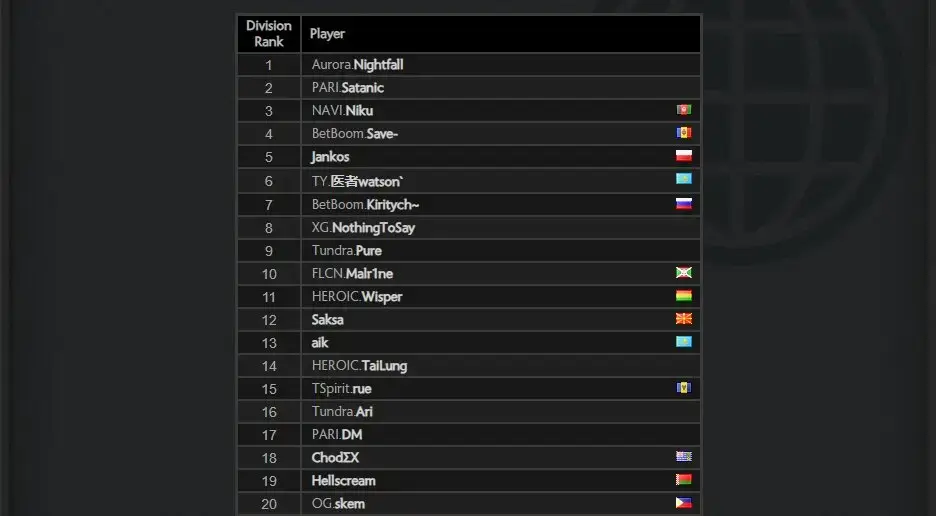
Immortal is Dota 2's highest tier and does not follow the standard five-star progression logic. When you reach this tier, your MMR continues to increase without an upper limit, and you can earn a numbered ranking on the regional leaderboard. These numbered placements bring special medal privileges to players who pass certain thresholds: top 5,000, top 100, top 10, and number 1 in their region. Immortal players outside these thresholds remain unnumbered and do not have any leaderboard position. Those with a numbered ranking are listed on Valve's official Dota 2 leaderboard.
It is possible to see the names of many professional players on this table; therefore, the leaderboard functions not only as an honor roll but also as a reference showing the real balance of power on the scene. Entering a numbered ranking means public proof that a player is among the best in their region. That is why, for high-level players, MMR is not just a personal metric but also a matter of visibility and prestige.
In July 2026, Valve made a significant adjustment to the Immortal MMR system and compressed the ratings, placing all players between 1 and 9,500 MMR at the moment of the update. The critical point in this change is this: players' positions relative to each other and their leaderboard rankings did not change at all. In other words, the adjustment changed not where players stand compared to their opponents, but only the numerical label attached to that position. Missing this distinction can cause players to panic with 'my MMR dropped'; yet as long as the relative position remains fixed, there is no real loss in ranking.
At the Immortal level, there is also an Immortal Draft mechanic that operates separately from standard ranked matchmaking. If you have at least 8,500 MMR, all ranked matches you play are conducted through Immortal Draft. Its practical consequences are quite strict: you cannot enter the ranked queue as a party, and you need to register an official name. These rules aim to preserve competitive integrity at the top of the league and ensure that matches are shaped by individual skill.
Is there really rank decay in Dota 2?
Short answer: Yes, it exists; however, it works a bit differently from what most players understand by this concept. When you stop playing for a long time, your MMR does not directly drop. Instead, Rank Confidence gradually decreases. When confidence falls below 30 percent, your account enters an uncalibrated state, and your MMR is hidden until you play enough matches to raise confidence back above 30 percent. So there is not a punishment, but a state of uncertainty.
When your confidence returns, your MMR becomes visible again, and depending on the performance in those matches, your rating may move up or down. Therefore, technically, there is no melting away in the form of 'rating loss.' Observations from experienced players suggest that after a long break, you generally do not move very far from where you left off. The exception is when Rank Confidence falls well below 5 percent; that roughly means you have not played for years.
The practical lesson to be drawn from this is: taking a break from the game for a while does not automatically set you back, but when you return, because the system will try to get to know you again, rating movements in the first matches may be more volatile. Seeing this period as a 'recalibration' prevents panicking in the face of sudden drops.
It should also be noted that MMR is not reset seasonally. That is, you do not start over with every new season. However, players who want to can reset their ranks using the MMR recalibration feature; this feature has a 365-day cooldown. So using this option is a one-time and long-term decision; it is a tool that should be considered not in haste, but when you truly believe it is necessary.
How to raise your rank in Dota 2? Five concrete tactics
Considering that you gain only about 25 MMR per match, progress may at times seem discouraging, especially for a player aiming for Immortal. But climbing in Dota 2 is not a sprint; it is a marathon. The five tactics below are designed to make this long journey more manageable; all are practical suggestions drawn from the game's own dynamics.
1. Stick to a single role
Some players try to learn every role and become a 'jack-of-all-trades,' but in reality this approach only slows down progress. The vast majority of professional Dota 2 players stay in a single role throughout their careers. If your goal is to climb consistently, adopting the same focused approach reduces unnecessary variance in ranked matches. Playing different roles means you have to adapt to a different skill set every match, and this directly undermines consistency.
2. Play at most three meta heroes
In line with specializing in a single role, you should focus on at most three heroes at a time. This focus helps you truly master those heroes and understand their limits. Also, if you pick heroes that are strong in the current meta, you gain an extra advantage; picking a strong hero gives you a chance to start one step ahead before the match even begins. This is a mechanically 'free' advantage, and there is no reason not to take it.
3. Don't flame your team
Dota 2 can at times be an extremely frustrating game, we all know that. But verbally attacking your teammates is the shortest path to a quick defeat. Once an argument starts, you lose focus on the game. Worse, if the other person responds, you now have two players on your team not paying attention to the game. Focus on playing the game until the Ancient falls, and save the argument for the post-match chat.
4. Improve your map awareness
No matter which role you play, the one thing that never changes is map awareness. Make it a habit to glance at the minimap every few seconds. Good map awareness not only helps you avoid unnecessary deaths; it also allows you to ping your team and warn them against incoming ganks, likely saving them. Although this may seem like an individual skill, it is actually a habit that directly turns into team gain.
5. Avoid chain queuing
This item is a more personal observation and a trap many players struggle with. When you are angry or not in the right mindset, you become prone to chain queuing. Playing while tilted usually leads to playing worse, and this can spiral out of control. By the time you notice, when you see eight losses in a row on your profile page, it is too late. Taking a short break after tough losses before requeuing is the simplest way to break this cycle.
Frequently asked questions
What do Dota 2 ranks represent? Ranks are the visual representation of your current skill level in ranked matches. They consist of eight tiers ranging from the lowest, Herald, to the highest, Immortal, and are displayed publicly on your profile.
How does the Dota 2 ranking system work? Your rank is determined by MMR, a numerical value reflecting your true skill level. This number changes after every ranked match; it rises when you win and falls when you lose. Individual statistics do not directly affect this change.
What is Dota 2's highest rank? The highest tier is Immortal. This tier operates through a live regional leaderboard based entirely on MMR instead of five-star progression; it has no upper limit, and numbered rankings bring special medal privileges.
Can you lose your rank in Dota 2? Not exactly. Technically, you do not 'lose' your rank because you were inactive. However, until you play enough matches and regain Rank Confidence, your MMR may remain hidden and your medal may appear uncalibrated.
Does rank reset every season? No, your MMR is not reset. However, players who want to can reset their ranks using the MMR recalibration feature; this feature has a 365-day cooldown.
Conclusion: manage the process, not the medal
Although Dota 2's rank system may seem complex at first glance, it is actually based on a single logic: your MMR reflects your true skill, and your medal is its visible face. When the Glicko-based infrastructure, the Rank Confidence mechanic, and the threshold structure come together, the resulting picture is quite consistent; the system does its best to place you somewhere, and all it wants is enough data. Therefore, what usually slows down your climb is not the system itself, but your own habits.
When you look at the distribution data, you see that the vast majority of players are concentrated in the Crusader and Archon bands, that Ancient represents the top 20 percent, Divine the top 10 percent, and Immortal only 4 percent. This picture clearly reveals how selective it is to reach the upper tiers. But it also shows a comforting truth: there are millions of players in the middle of the ladder, and this is proof of how broad a base the competition spreads across.
The healthiest approach from here on is to keep your goals small. Aiming to move up one star, then advance to the next tier, is far more sustainable than locking onto a distant goal like 'I will become Immortal this season.' Stay in your role, narrow your hero pool, track the map, and do not queue while tilted. These four habits turn into MMR over time; the medal will follow anyway. Remember, even Immortal contains a huge gap within itself; in other words, there is no finish line to climbing, only tougher opponents.