
Although Rocket League is one of the titles that defined the car football genre, the part that confuses players the most is usually its rank system. Winning matches and ranking up seems easy at first, but after a while the question "why am I still stuck in the same rank?" becomes inevitable. The main reason behind this is that the game largely hides the ranking-up mechanism from the player and does not show points directly on the scoreboard. In this guide, we cover step by step how competitive playlists are separated, the order in which all ranks are arranged, the division logic, and the behind-the-scenes workings of the hidden MMR system.
Competitive playlists: How many modes are there and how do ranks unlock?
When you open the game and click the Competitive tab, you are presented with three main playlists: 3v3 Standard, 2v2 Doubles, and 1v1 Duel. These three form the competitive backbone of the game, and each has its own separate rank. In other words, being Diamond in 2v2 does not mean you are at the same level in 1v1 — you need to rank up separately for each mode. This separation comes from the fact that team play and one-on-one competition require completely different skills.
For your rank to become visible in the game, you must play a total of 10 matches in each playlist. This means that if you want to be ranked in all three main modes, you need to play 30 matches in total. During these matches, the game measures and places you according to your opponents' level; therefore, the first 10 matches essentially serve as a kind of placement test. It is normal to get very easy opponents in your first matches or, conversely, to face very tough matchups — the system is still trying to get to know you.
Besides the main modes, there are also side competitive playlists. 2v2 Hoops is one of them; on the 3v3 side, Dropshot, Snow Day, and Rumble are available. Although these modes offer fun variations, the core competitive experience of the game is defined by the main trio. It is important to remember that ranks you earn in side modes progress separately and do not directly affect your rank in the main playlists. Some players use these modes as a warm-up or mechanical practice area, which is a very reasonable approach.

All ranks and tiers in Rocket League
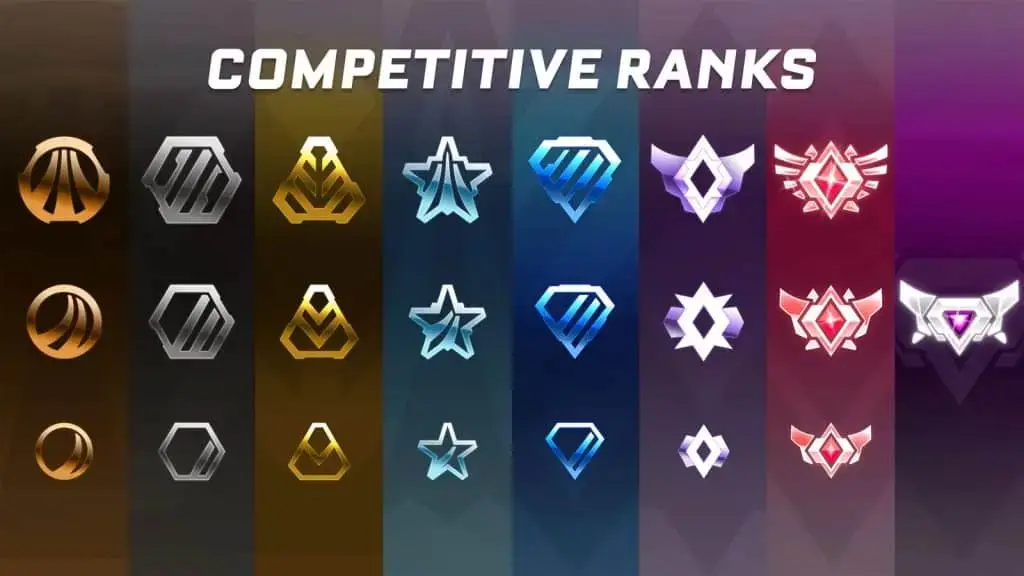
After completing the 10 matches required to get out of Unranked, you can climb through a total of eight ranks. Seven of these ranks are divided into three tiers. The table below shows all the ranks in the game and their associated tiers in full:
| Rank | Tiers |
|---|---|
| Unranked | – |
| Bronze | I, II, III |
| Silver | I, II, III |
| Gold | I, II, III |
| Platinum | I, II, III |
| Diamond | I, II, III |
| Champion | I, II, III |
| Grand Champion | I, II, III |
| Supersonic Legend | – |
The table also explains why the system seems complicated at first glance. When seven of the eight ranks are divided into three sub-levels each, 21 different intermediate levels emerge. Moreover, the lowest and highest points remain outside this division: Unranked represents the period when you have not yet received a rank, while Supersonic Legend stands as the single top step of the game that is not divided into tiers. This structure gives players a sense of continuous progress while also making separation at the highest level sharper.
Although reaching Grand Champion is a long-term goal for many players, the real test begins at the Supersonic Legend level. Because once you get there, there are no intermediate steps such as tiers or divisions; you are either at that level or you are not. This makes the highest rank both more prestigious and more fragile.
Division logic: Climbing within the same rank
In addition to each rank being divided into three tiers, each of these tiers is further divided into four divisions: Division I, II, III, and IV. So, for example, if you are at Gold I Division II, you have two more divisions to get through before moving to Gold II. This layered structure clearly shows why the system contains so many intermediate steps.
In practice, this means: winning a single match does not move you up a rank. Promotion is shaped gradually by the balance between matches you win and lose. Going back and forth in the same division for a long time shows that the system is balancing you at that level. Although this may seem like bad news, it is actually a positive sign for matchmaking quality: the system is trying to match you with players at a similar level.
The biggest benefit of understanding the division structure is that you can measure your progress realistically. Instead of goals like "I will be Diamond this week," setting smaller and more concrete goals like "I will reach Platinum III Division III this week" both preserves motivation and makes it easier to track improvement.

What is MMR and why is it hidden?
Behind the ranks runs a hidden rating system called MMR, or Matchmaking Rating. This score is constantly updated based on the matches you win and lose, but under normal circumstances it is not shown to the player. This approach is a familiar choice also seen in other competitive games such as CS:GO: the aim is to keep players from focusing on the number and disconnecting from the match itself.
There is an important detail that sets Rocket League apart from similar games at this point. Your individual performance in the game — the number of goals you score, the saves you make, your time on the ball — does not directly affect your MMR. The system only looks at the result of the match. In other words, if you play a perfect match and lose, you lose points; if you play mediocre and win, you gain points. This rule makes individual stat-chasing meaningless in team play and forces the player to focus directly on winning.
There is only one moment when the MMR curtain lifts: according to sources, when you reach Champion I, your hidden score begins to appear in the game menus. This threshold can be thought of as the game's message that "you are now a high-level player, you can see the details." Until this level, all you need to do is focus on winning matches; trying to track the numbers would only be an unnecessary source of stress.
What does the rank system tell you in practice?
Ranks are not just an indicator; they are also a feedback mechanism the game gives you. If you stay at a certain rank for a long time, this usually means your mechanical skills or game-reading habits have reached their limit at that level. To rank up, you need not only to play more matches but also to practice deliberately on things such as aerial control, angles for meeting the ball, passing choices, and defensive positioning.
The system's mode-based separation also makes this development more readable. Ranking up in 1v1 highlights individual mechanics and decision-making speed, while ranking up in 2v2 and 3v3 highlights team coordination and space sharing. Therefore, instead of focusing on a single mode, gaining experience in different playlists can noticeably increase your overall game intelligence. If you want to see your own weak points, 1v1 matches serve as a harsh but instructive mirror.
Although the road from Unranked to Supersonic Legend may seem long, each step actually corresponds to learnable skills. At Bronze and Silver levels, basic control and meeting the ball become established; at Gold and Platinum, consistency comes to the fore; at Diamond and above, speed, positioning, and decision quality become decisive. Therefore, reading your rank not as a talent label but as a development map is much more useful.
More guides for your rank journey
After understanding the rank system, it is time to improve the technical side of your game. The following guide topics cover the subjects players who want to push their rank higher need most often:
- Best Rocket League settings guide
- How to Air Roll in Rocket League
- Best Rocket League hitboxes
- How to get Alpha Boost
- Best cars in Rocket League
- Rocket League codes
These topics form a complementary whole: the settings guide helps you understand the game's responsiveness and feel of control, the air roll guide helps you understand your mechanical ceiling, and the hitbox and car guides help you understand how your preferred car actually behaves. Codes, meanwhile, are a separate topic for those who do not want to miss in-game rewards.
Conclusion: Reading your rank correctly
Although Rocket League's rank system may seem complicated at first glance, its logic is quite consistent: a separate rating for each mode, three tiers for each rank, four divisions for each tier, and behind all of it a hidden MMR that only looks at match results. The only guaranteed way to rank up is to win more; for that, you need to develop mechanical practice and game-reading skill together. The road from Unranked to Supersonic Legend demands patience, but every division jump gives you a concrete sense of progress. When setting your next goal, aim for the division in front of you rather than the next rank — the system is set up to reward exactly that.