
Mobile Legends: Bang Bang (MLBB) has built its own ecosystem within the mobile MOBA genre, a game that is constantly updated and whose competitive side never lets up. What keeps a large portion of players in the game is not just new heroes or the event calendar; it's the sense of progress that ranked mode provides. Climbing step by step, starting a new season with a better badge at the end of the season, and having matches matched with players close to your own level turn MLBB into a long-term habit. In this guide, we cover from start to finish the mechanics of the rank system, what the tiers actually expect from the player, and which habits you need to acquire to speed up your climb.
The star logic: what sets MLBB apart from other MOBAs
MLBB's ranked system, unlike most of its rivals, does not work with fixed MMR values. Instead, each division is divided into stars, and gaining or losing a star is tied directly to the match result: every match you win adds a star, every match you lose takes one away. When you fill the number of stars required for a division, you automatically advance to the next division. This structure is easy to learn because it makes the number you see on screen accountable to the player rather than relying on hidden math; but it also mercilessly shows how quickly losing streaks pile up.
The number of stars required per division changes from tier to tier, and this is the most concrete detail that determines the pace of the climb. In Warrior, 3 stars are enough for each division, while in Elite and Master this number rises to 4. In Grandmaster, Epic, and Legend, each division requires 5 stars. In Mythic and above, the table changes completely: stars give way to Mythic points, and the climb progresses on a point-accumulation logic. This transition is actually the clearest line the game draws between a "new player" and a "competitive player."
The practical result is this: in lower tiers, losing a single match barely sets you back in your overall progress. As your tier rises, both the stars required per division increase and your opponents' margin for error decreases. In other words, a bad streak in Legend costs you much more than a streak of the same length in Master.
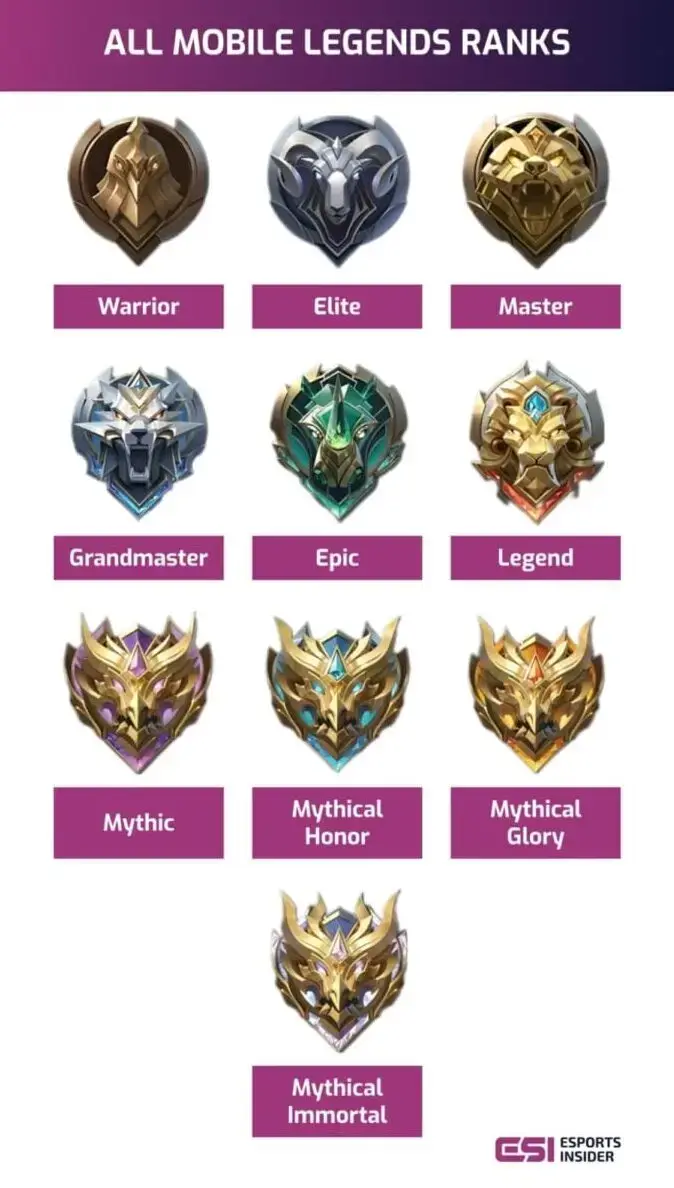
The complete list of Mobile Legends ranks in 2026
As of 2026, there are seven main ranks in the game, and most of them are divided into three to five sub-divisions. Mythic, however, is not divided into numbered divisions; instead, it is split into upper tiers called Honor, Glory, and Immortal based on Mythic points. The table below summarizes how many divisions each tier has, how progression works, and what that tier expects from the player.
| Rank Tier | Divisions / Sub-tiers | Progression | Description |
|---|---|---|---|
| Warrior | III → II → I | 0–3 stars | Starting tier. No star loss. Helps new players understand basic gameplay. |
| Elite | III → II → I | 0–4 stars | Core mechanics are tested. Competition level rises slightly. |
| Master | IV → III → II → I | 0–4 stars | Coordination and role knowledge begin to matter. |
| Grandmaster | V → IV → III → II → I | 0–5 stars | Transition stage. Mistakes are punished more harshly. Team synergy becomes decisive. |
| Epic | V → IV → III → II → I | 0–5 stars | Draft Mode starts here. Hero banning and counter-pick moves add strategic depth. |
| Legend | V → IV → III → II → I | 0–5 stars | High-skill matches. Macro play and team coordination play a critical role. |
| Mythic | – | Approximately 0–599 Mythic points | Advanced tier. All matches are played in Draft Mode. Requires high mechanics, correct decision-making, and consistency. |
| Mythical Honor | – | Approximately 600–999 Mythic points | Strong players who perform consistently. Matches are extremely competitive and demand precise execution. |
| Mythical Glory | – | Approximately 1000+ Mythic points | Elite tier. Semi-professional level play. Mastery in multiple roles and deep game knowledge are required. |
| Mythical Immortal | – | Top 50–100 per server, high Mythic points | The most prestigious tier. Reserved only for the best players, visible on leaderboards. Requires exceptional skill and dedication. |
Looking at the table as a whole, the system actually splits into three distinct periods. The first period consists of Warrior and Elite; here the game tries to teach you mechanics, map flow, and the concept of roles, while keeping the cost of losses low. The second period is Master and Grandmaster; a springboard where team synergy and role knowledge come to the fore, and mistakes are now truly punished. The third period is Epic and Legend; where Draft Mode comes into play and most matches start being won on the selection screen.
When you factor in the sub-divisions, the total number of tiers swells considerably. According to the calculation cited by the source, when each division is counted as a separate tier, this number reaches 27. This is an important detail in showing how long a player's journey from zero to Mythical Immortal is; because the first half of the climb is often learning, and the second half is a race of consistency.

Mythic and beyond: Point-based elite tiers
The moment you reach Mythic, the rules of the game change fundamentally. The star-gaining era ends and is replaced by Mythic points. In this tier there are no numbered divisions anymore; the climb is measured entirely by accumulated points, and this creates an environment where winning back-to-back is not enough on its own. According to the ranges cited in the source, Mythic covers roughly the 0–599 point band, and all matches here are played in Draft Mode.
Mythical Honor is the tier corresponding to roughly the 600–999 point range. Players who reach here are generally names that show consistent performance, rising through repeatable quality of play rather than accidental wins. Matches become far more competitive, and a single bad positioning or a poorly timed team fight can directly lose the match. In this tier, what is decisive is not "playing well" but "playing at the same level consistently."
Mythical Glory corresponds to approximately 1000 and above Mythic points and is defined as the elite tier. Semi-professional level play is expected: specializing in a single role is not enough; mastery in multiple roles and deep game knowledge are required. Players here are generally those who follow meta changes, keep a wide hero pool, and plan the match from the selection screen onward.
And at the very top is Mythical Immortal. This tier covers only the top 50–100 players per server and requires high Mythic points. It is defined as the most prestigious rank; it becomes visible on leaderboards and is an area that demands exceptional skill and dedication. So Mythical Immortal is the reward not just for being a good player, but also for playing consistently throughout the season. To understand the scale of the competition here, it is enough to consider this: only a very small percentage of the total ranked player pool can remain within this band.

Draft phase: The strategy layer starting at Epic V
The moment you reach Epic V, the Draft phase comes into play at the start of ranked matches and the character of the game changes. The Draft works in three stages. The first stage is banning: each team can ban up to four heroes, and your teammates can also offer ban suggestions. This stage gives you the opportunity to take away your opponent's strongest weapons before the match begins.
The second stage is selection: each player picks their hero in turn, and the same hero cannot be picked twice. The third stage, which most players underestimate, is Final Adjustment: after all picks are complete, you can customize your builds and emblems, and even swap heroes with your teammates. This final window is designed for you to see the opposing team's composition and adjust your own plan at the last moment, and when used well it significantly affects the course of the match.
The practical meaning of the Draft phase is this: in tiers below Epic, most matches are won through mechanics and individual performance; in Epic and beyond, a significant part of the match is determined on the selection screen. A player who does not know which hero is strong against which opponent will struggle in these tiers no matter how good they are mechanically.
Star protection and promotion points
The most wondered-about but least understood part of the rank system is two separate point indicators: star protection and promotion points. Star protection prevents you from losing a star after a match you lost when your indicator is full or when you use a Star Protection Card. So it acts as a buffer that keeps you standing for a while when you enter a bad streak.
Promotion points work in the opposite direction: they accumulate with consistent victories, and when they reach a certain threshold, they grant you an extra star on your next victory. The fill rate of both indicators depends on your individual performance. Being MVP or getting first blood earns more points; this noticeably accelerates the climb of a player whose true level is above the tier they are in.
When these two mechanics are considered together, MLBB's design philosophy emerges: winning is rewarded more generously than losing, and star protection slows down the sudden erasure of progress. So as long as you maintain a healthy win rate, the system keeps carrying you upward; the point is not to shine in a single match but to stay above average in the long run.
Losing rank: Defeat, season reset, and inactivity
Star protection cannot protect you forever. If you keep losing, this mechanic only delays the inevitable; it does not mean progress is guaranteed, and eventually a tier drop happens. When you enter a bad streak, the best move is usually to leave the game for a while; because consecutive losses drag down both your points and the quality of your decision-making.
Defeat is not the only way to drop. At the start of each season, a rank reset is performed and your new tier is determined relative to the previous one. The rule is simple: the higher your tier, the bigger your drop. This reset does not apply to Warrior and Elite, so the game protects new players in this regard. The season duration stated in the source is about three months; so you need to build your climb plan around this cycle.
Inactivity, on the other hand, does not directly affect rank; because your new tier is only determined when you first log in during the new season. You keep your old rank, but this rank does not reflect on the leaderboard, so in practice it does not mean much. There is also a harsh consequence: accounts that remain inactive for more than six months can be deleted by Moonton.
On the matchmaking side, you can generally enter the same match with players one tier above or below your own. For example, a Grandmaster player can be matched with players between Master and Epic. According to community observations, bots can also appear in ranked matches, and they usually show up in lower tiers. There is no definitive data for 2026 on rank distribution; however, based on inferences from other MOBAs, lower tiers are more crowded, Epic and Legend are the band with the highest active player density, and Mythic Immortal remains below even one percent of total players.
What should you do to rank up faster?
Knowing the system alone is not enough; the other half of the climb is in habits. The following items are the highest-return steps for players who want to rise faster with the same number of hours:
- First, master a single role: At the start, you need to try all roles and understand which one suits you; early specialization turns you into a better player quickly. After choosing your main role, truly learn two or three heroes in that role. Each hero has its own subtleties, and these only settle in with regular play. This approach also solidifies your item and build knowledge, because you need to know how which item interacts with your main heroes. As you climb the early tiers, learning a second role is also a big advantage; the Draft phase at Epic V and beyond can push you into a role or heroes you don't want.
- Play with consistent teammates: Queueing alone makes every ranked experience based on team play harder. Fortunately, adding friends in MLBB is very easy: from the post-match screen you can add standout teammates and play with them. A fixed squad that knows each other's playstyle and has complementary skills makes communication easier, and in higher-level matches communication directly decides fate.
- Learn heroes and counter-picks: From Epic V onward, choosing the right hero depends on knowing which hero is strong against whom. In the ranking tab on the game's official website, you can see the season's most-picked heroes, their win rates, and the best options against them. Adapting this data to your own matches concretely speeds up the climb.
- Follow updates and patches: Every update brings new content and events, but behind the scenes there are usually balance changes. Since Moonton regularly shifts the meta by applying buffs and nerfs to different heroes, following these changes means knowing how effective your main heroes still are.
The common point of these four items is that they are all an investment different from "playing more." Narrowing your hero pool reduces decision load, a fixed team lowers communication costs, counter-pick knowledge eliminates mistakes on the selection screen, and patch tracking saves you from falling behind. When applied together, you get a higher win rate with the same number of matches.
Meta changes and long-term progress
In MLBB, no hero or strategy remains permanently strong. While a balance patch carries one hero to the top, the same update can push another into the shadows, and this means a climb recipe that worked in the past can become ineffective a few patches later. That is why meta tracking becomes critical not for beginners, but for players stuck in the middle of their climb.
A healthy approach is to keep two or three options alive in your main role instead of becoming overly attached to a single hero. Thus, when patches weaken your main hero, your climb does not stop; only your route changes a bit. The same applies to the matchmaking pool: as your tier rises, your opponents' knowledge increases, and an aggressive playstyle that worked in lower tiers can turn into a habit that gives openings in Legend and beyond.
Conclusion: Climbing is a game of patience and consistency
At first glance, Mobile Legends' rank system seems to consist only of collecting stars; yet beneath it there are three different layers. The star system provides fast progress in lower tiers, the Draft phase moves the match to the selection screen from Epic onward, and after Mythic, point-based tiers begin the game's real competitive test. Being aware of these three layers means knowing which skill to invest in at which tier.
For players who reach the top, MLBB is also a showcase: high tiers are an area where you can attract the attention of esports teams looking for new talent. For those who enjoy the climb, matches are more balanced and more instructive because they are matched with players at a similar level. In both cases the result comes to the same place: knowing how the system works helps you progress faster than just playing.
In short, the to-do list is short: go deep in one role and a few heroes, play with consistent teammates when possible, use counter-pick data, follow patches, and maintain a positive mindset. When these habits come together, the road from Warrior to Mythical Immortal becomes long but definitely walkable.