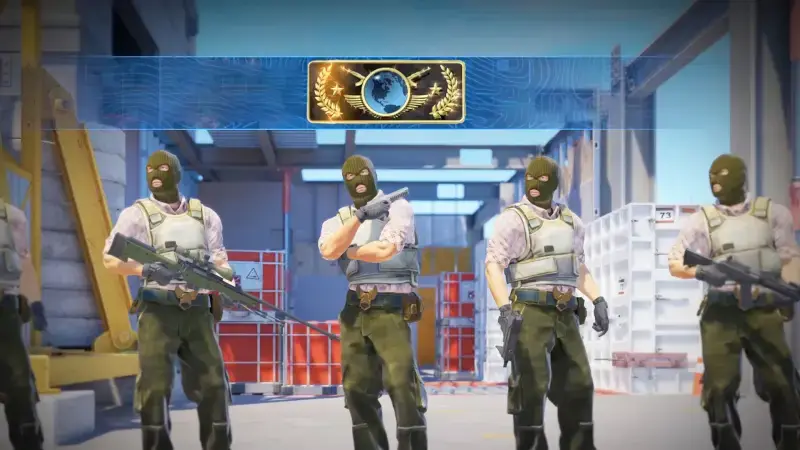
Counter-Strike 2's competitive side presents players with two separate progression paths compared with earlier games in the series. One is the map-based ranks familiar from CS:GO, and the other is a fully numerical CS Rating. Though it may sound complicated, this duality is really Valve's two different answers to the question "How do you want to play?" Some players prefer to climb at their own pace on their favorite map, while others want to be compared with the rest of the world through a single universal score. Since your rank in CS2 is now calculated separately depending on which mode you play, understanding the logic of both systems really makes a difference when planning your progress.
Structural differences between Competitive and Premier
One of CS2's biggest innovations is that it takes competitive play out of a single mold and separates it by mode. In Competitive mode, map choice is left entirely to the player: you select the map you want and join the queue, and your performance is measured by a rank specific to that map. In Premier, almost the opposite approach applies — before the match begins, teams pick and ban maps, meaning you cannot decide on your own where you will play.
When making this distinction, Valve also removed the short/long match option from CS:GO; now the MM24 format applies in both modes, meaning less waiting and more direct action. This choice makes match lengths much more predictable from the player's perspective. Premier's map-selection pressure, however, has an indirect but powerful effect: a player who only knows Dust 2 weakens their hand during the ban phase and puts their team in a tough spot. Competitive, by contrast, lets you compete even with limited map knowledge. That's why many players use Competitive as a training ground to improve before moving on to Premier.
How is CS Rating calculated and what does it mean?
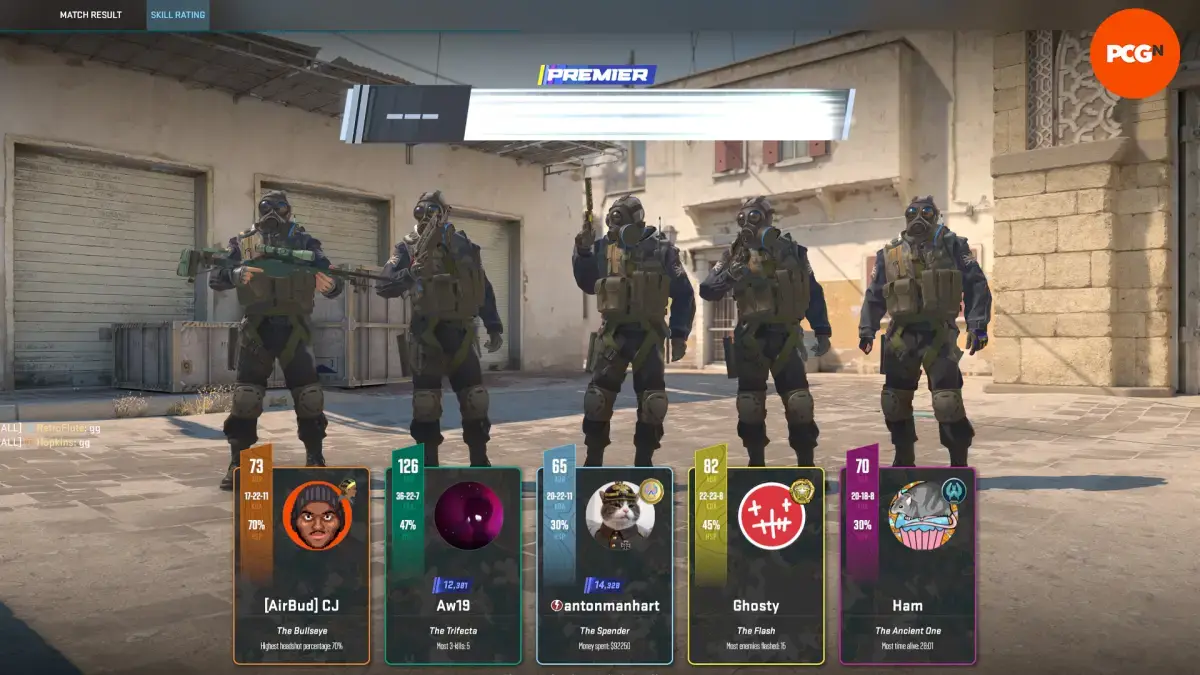
In Premier mode, the first step is to complete ten placement matches. When those matches are over, you are not shown a rank icon but a direct number: CS Rating. This number represents your position in the global Counter-Strike 2 leaderboards — clearly showing where you stand among other players around the world. Though it may feel strange at first to players used to rank icons, the system's logic is quite transparent.
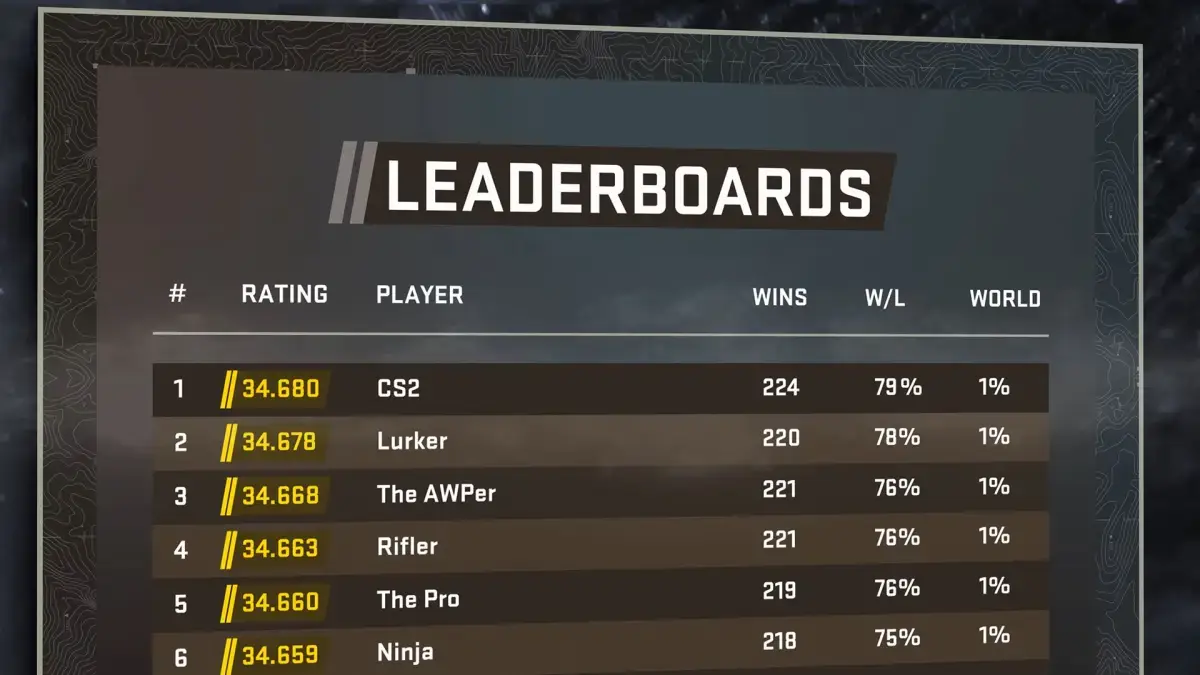
The system works with three different tables: rankings among your friends list, rankings in your region, and global rankings. These tables are broken down not only by your total score but also by number of wins, win rate, and percentile. This way, the questions "How many matches have I won?" and "How well am I playing?" can be answered independently of each other. Because your score updates after every match, you do not experience prolonged uncertainty about whether you are where you deserve to be, and you can track your progress with a concrete number.
At this point, one of the clearest blows CS2 strikes against CS:GO comes into play. The old ELO system did not tell players how many wins remained until the next rank, which turned the promotion process into something of a black box. CS Rating removes this mystery, because the score is directly visible. Still, one should not assume the system is entirely static: with the Arms Race update released on February 7, a restriction was introduced on participation for a player who queues with a five-person group and has never received a rank. This rule does not cover players who lost their rank due to inactivity (decay); it only affects people who have never earned a rank before.
CS Rating ranges and rank equivalents
The first score you receive when you complete your placement matches may surprise you. Especially if you never went on a win streak during placements, it is quite likely that you will start in the lower ranges. Fortunately, CS2 has a mapping table showing which classic rank a numerical score corresponds to.
- 1,000 – 4,999 (gray): Silver 1 – Silver Elite Master
- 5,000 – 9,999 (light blue): Gold Nova 1 – Gold Nova Master
- 10,000 – 14,999 (dark blue): Master Guardian – Master Guardian Elite
- 15,000 – 19,999 (purple): Distinguished Master Guardian – Legendary Eagle Master
- 20,000 – 24,999 (pink): Supreme Master First Class
- 25,000 – 29,999 (red): Global Elite
- 30,000 and above (gold): Top 1%
The table clearly shows that you need to accumulate a serious score to climb out of the Silver ranks. But starting with a low score is not the end of the world: if you win ten more matches after placements, especially if you truly started in the wrong place, you will see your score move noticeably upward. It is also worth noting that these ranges can fluctuate depending on the player population — meaning the boundaries are not absolute and can shift according to the community's overall distribution. Therefore, a score that was Global Elite in one period may correspond to one tier lower in another.
Map-based ranks in Competitive mode
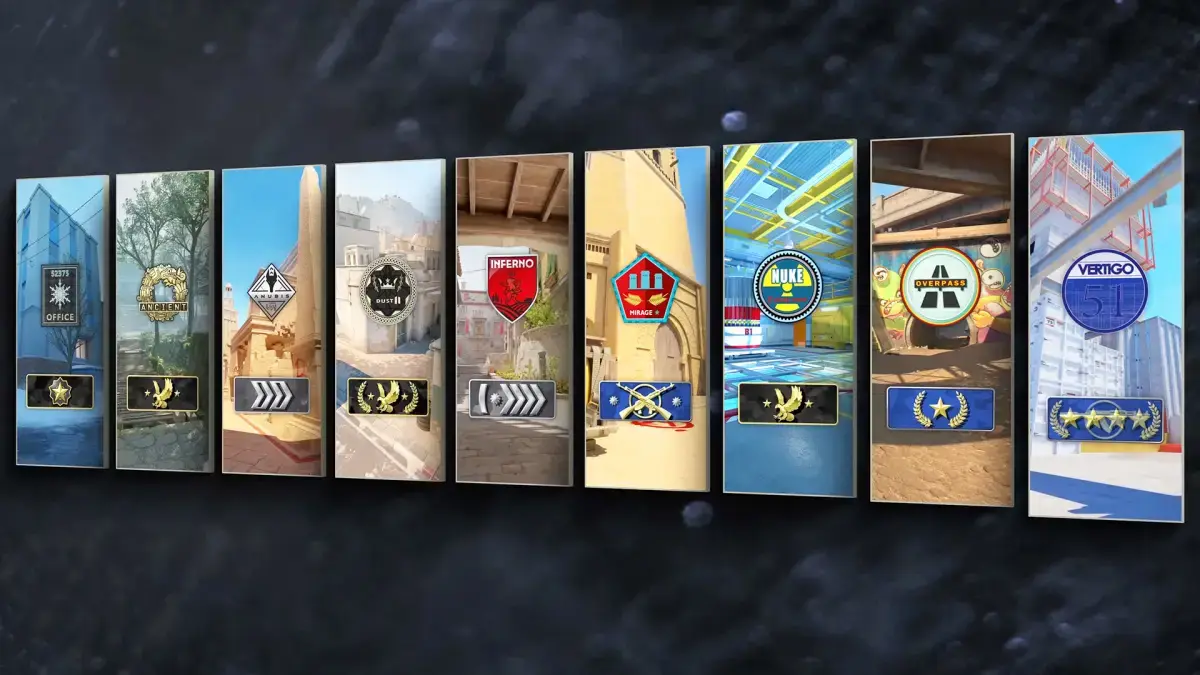
When you enter Competitive mode, you are greeted by the classic rank ladder familiar from CS:GO. These steps, stretching from Silver 1 to Global Elite, are calculated separately for each Active Duty map. In other words, a player who has spent thousands of hours on Dust 2 can climb their rank on that map all the way to Global Elite, while their rank on Vertigo, which they have barely played, may remain much more modest. This is one of the fairest aspects of the system: as your map knowledge increases, your rank reflects it.
In practice, this means that when you learn a map and raise your win rate on it, you will see your rank rise quickly as well. This is exactly the point underlined in Valve's Counter-Strike 2: Beyond Global video: Competitive is an extremely suitable place to improve your map pool before moving on to Premier. Playing each of the seven Active Duty maps at least once is the simplest way to close your team's blind spots. Especially for those new to the game, this provides rapid development both mechanically and tactically.
It is also worth remembering that promotion speed is not determined solely by number of wins. Your individual performance in each match affects the outcome; in addition, playing in a group with players significantly better than you can cause Valve to slow your progress. The existence of players in the CS:GO era who won ten matches in a row and remained at Gold Nova 2 suggests that the system also takes variables other than match history into account behind the scenes. In short, it is not just winning that matters, but how you win.
All ranks in CS2
The entire classic ladder progresses in this order:
- Silver 1, Silver 2, Silver 3, Silver 4, Silver Elite, Silver Elite Master
- Gold Nova 1, Gold Nova 2, Gold Nova 3, Gold Nova Master
- Master Guardian 1, Master Guardian 2, Master Guardian Elite, Distinguished Master Guardian
- Legendary Eagle, Legendary Eagle Master, Supreme Master First Class, Global Elite
The smurf problem and Prime Status
One of the most annoying issues in competitive CS2 is whether the player you face is really at that rank. In some matches, you will see a name on the opposing team performing far above everyone else; if it is certain they are not cheating, you are most likely facing a smurf. A smurf means an experienced player appearing against lower-ranked opponents, usually with a newly created second account. This completely disrupts the competitive balance of the match and poisons the learning process for new players.
Because CS2 is free to play, the number of smurfs is quite high. It is impossible to completely escape this problem, but there is a way to reduce your chances of encountering it: upgrading your account to Prime Status. This $14.99 upgrade matches you only with players who have Prime status. Interestingly, some smurf accounts also agree to pay this fee to avoid dealing with cheaters; so Prime does not completely end the smurf problem. Nevertheless, the frequency of encounters drops noticeably, so upgrading to Prime stands out as a sensible investment for a player who takes the game seriously.
Party restrictions: who can queue together?
CS2's party rules are another detail that directly affects your mode preference. Competitive mode is the only place that allows playing in four-person groups. In Premier, Valve has banned four-person groups; to join the queue, you either need to find a fifth player or remove one person from the group. The size of your friend group becomes a factor that, without you realizing it, determines which mode you play.
Valve has not officially explained the rationale for this restriction, but the theory that stands out in the community is quite reasonable: a four-person group has an excessive advantage over the single random player on the team. When voice communication, game plan, and decision-making are entirely controlled by the group, the fifth player can feel left out of the match. This restriction can also be read as a measure to protect the match experience of randomly matched players. So if you have a four-person team, you must choose either to stay in Competitive or to convince one more friend to join.
What does this system mean for players?
CS2's rank and rating structure offers two parallel progression lines instead of a single ladder. Although this may look like complexity at first glance, it actually gives players more control: if you want to improve your map knowledge, Competitive is the right place; if you want to measure yourself by a single universal score, Premier is the right address. It is also important not to forget that the two modes feed each other — the map mastery you gain in Competitive directly helps you in Premier's ban phase and your overall performance. That's why it is healthiest to think of the modes not as alternatives to each other but as complements.
For beginners, the healthiest path is to first expand your map pool in Competitive, then enter Premier's placement matches. Getting a low CS Rating after placements can be discouraging, but the system rapidly moves your score upward with regular play. Conversely, if you stop playing regularly, it is completely normal for your rank to decay over time; this is part of the system rewarding active players. Ultimately, a rank in CS2 is not an achievement won once and put on a shelf, but an indicator that requires constant maintenance. The system's numerical structure supports this too: the more you play, the clearer your position becomes.