Valve has released a new update for Counter-Strike 2, and the patch is now live for all players. Looking at the patch notes, two main topics stand out: fixes made to the Cache map along with spawn adjustments, and the encryption of chat logs in demo files. Although at first glance it may look like a routine maintenance update, the second item directly touches on a privacy issue that the game has been discussing for months. In other words, this patch concerns both gameplay on the map and the game's social layer at the same time. So what exactly changed and what do these changes mean for players?
To understand why the issue attracted so much attention, it is necessary to look at CS2's demo system. Demo files, which are recordings of a match, can be examined within the game itself and with third-party tools; for a long time these files also contained in-match chat logs. Therefore, a message a player wrote during a match could be seen and collected by others even weeks after the match ended. Valve's latest patch aims to cut off exactly this flow.
Cache adjustments: gaps, wallbang, and new spawn points
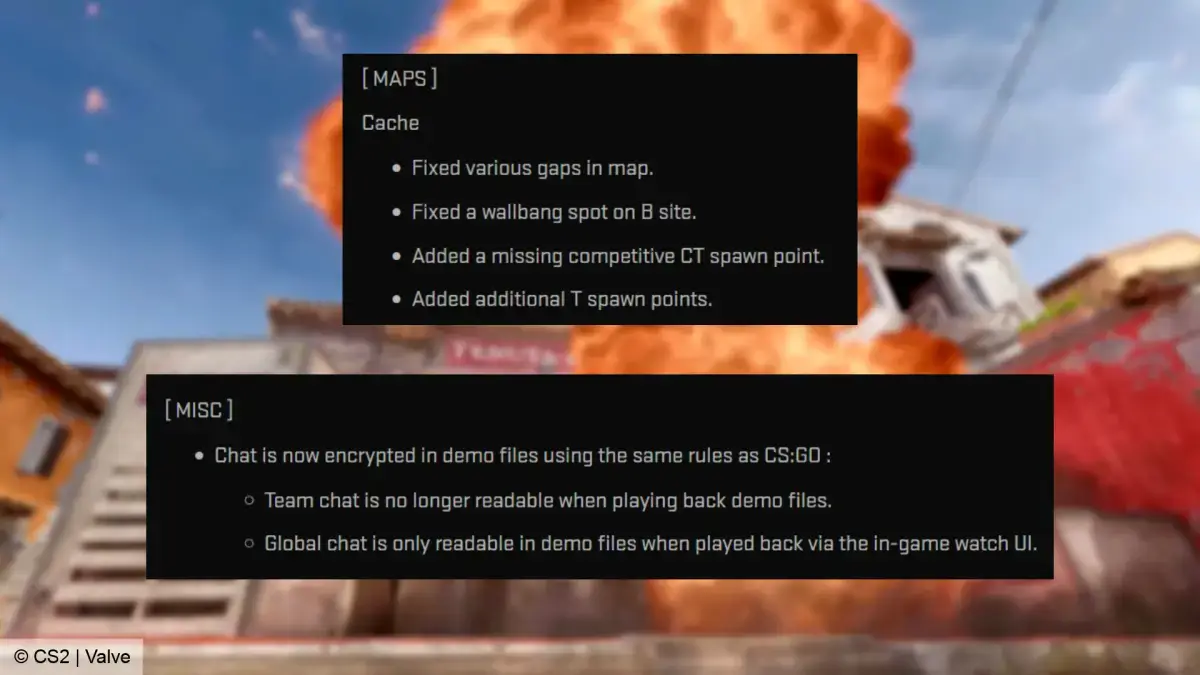
The most concrete part of the update is devoted to the Cache map. Cache joined the active map rotation in its revamped form in April, and since then it has been at the center of both nostalgia and competitive balance discussions. In this patch, Valve fixed "gaps" in various areas of the map; such openings can allow players to gain unexpected lines of sight or cause bullets to behave strangely. In addition, a wallbang spot detected in the B site was also closed. These small but effective touches on the map are taken seriously because they can directly affect round outcomes, especially in high-level matches.
The most talked-about part of the patch is the change to spawn points. While Valve added a competitive spawn point for the counter-terrorist side, it gave the terrorist side several new spawn points. Spawn adjustments may sound like an insignificant detail, but in fact they rewrite the first seconds of the map: which player will reach which point and in how much time, where the first contact will happen, and how early-round rotations will take shape all depend on these starting positions. Therefore, adding or changing the location of a spawn point can require teams to rethink their round plans and default setups. For competitive players, this means a new routine they need to get used to within a few days.
Some of the map fixes also consist not of visible bugs but of "small advantages" that players discovered over time. A spot that can be shot through from behind a wall or a faulty floor gap can both disrupt the map's fair gameplay and become a topic of debate in tournament matches. Valve clearly stating such spots in the patch notes eliminates the community's question of "was this left in intentionally?" and leaves a positive impression in terms of transparency.

Spectator experience and new features in map scripts
The patch is not limited to the map and chat; there are also adjustments on the map scripts and spectator side. Valve added new commands for player camera controls and introduced a setting that determines whether observers see the interface the player they are currently watching sees. In addition, it fixed "a few bugs" that could appear when switching between different spectator targets. These changes are especially meaningful for broadcasts, tournament productions, and community tools that review demos.
A spectator being able to align the camera with the player's point of view or see the exact interface the player sees is a detail that directly affects broadcast quality. In tournament broadcasts, instant position tracking, watching decisions made from the player's perspective, and referee reviews rely on such tools. Fixing the bugs experienced when switching targets reduces visual glitches and confusion on the viewer's screen. Although these items may seem small at first glance, they strengthen the bridge between the professional scene and the ordinary player experience.
Chat in demo files is now encrypted
The most critical item of the update concerns chat logs. According to Valve's explanation, chat is now encrypted in demo files with the same rules as in CS:GO. In practice, this means that when playing back a demo, team communications cannot be seen at all, while general chat can only be read when actively played back with the in-game viewing interface. In other words, chat does not disappear completely, but it ceases to be a data layer that can be extracted in bulk from the file.
From a technical standpoint, this adjustment is a very logical choice for anyone familiar with CS2's demo ecosystem. The aim is to block third-party tools that inspect the demo file itself, export in-match conversations, and turn them into databases. The fact that general chat can be seen during live playback preserves legitimate use cases: someone actually watching a match can continue to see what was said in that match. The encryption being the same as the rules in CS:GO also shows that Valve sees this approach not as a new experiment but as an old and known standard.
The biggest effect of this change is that chat data can no longer be scanned in bulk. To watch a match, you need to open the game, load the demo, and move along the timeline; this makes automated data collection technically cumbersome. Developers of community tools will certainly look for new methods for a while, but Valve tightening control over the demo side shows that it intends a permanent solution.

How did "toxic leaderboards" emerge?
To understand why this patch was necessary, it is necessary to return to the situation discovered in August. At that time, it emerged that CS2 tracking tools could publicly display chat logs from past matches. Sites like CS2tracker began scanning chat history and counted how many times players wrote insulting expressions in general chat, turning these into rankings. Although the resulting picture was technically "data," in content it put the game's worst side on display.
The real problem here goes beyond the privacy violation: when a ranking table was published, some players perceived it as a challenge. Climbing in these tables, which listed those who used the harshest expressions, began to be seen as a kind of achievement, and people were driven to test how far they could go. According to the information conveyed by the source, a real incentive mechanism had formed: bad behavior earned visibility and "ranking." This kind of loop is a much more structural problem than a single player's message written in a moment of anger during a match.
Moreover, these tables could turn even a single sentence an ordinary player wrote years ago into a permanent label by detaching it from the match context. Who collected chat logs, for what purpose, and how long they were stored was never transparently explained. This uncertainty directly affects the fun side of the game: when players cannot speak comfortably during a match, the social fabric itself is damaged. Therefore, Valve's step targets not only bad behavior but also the infrastructure that produces data from bad behavior.
What does this patch solve, and what does it not solve?
Encryption is an important gain because it eliminates the engine of "most toxic player" rankings. It is no longer directly possible for third-party sites to scan chat history in bulk and produce statistics; therefore, the visibility mechanism that rewards bad behavior also weakens. This largely renders meaningless the calculation of someone thinking about writing an insult during a match: "I wonder if I'll make the list." This is exactly where the patch is strongest.
However, it would be too optimistic to say that encryption ends in-game toxic behavior itself. Negative experiences during matches via voice chat or instant messages will continue; what changes people's behavior is usually not a file format but community norms and moderation tools. This patch reduces the visibility of the problem and removes the reward mechanism, but it does not touch the root of the behavior. In other words, it is valuable as a deterrent step but limited as a comprehensive solution.
Another topic of discussion is the side effects of the change. Demo files are widely used in community self-policing, content creation, and match analysis; it is not yet clear how making team communications completely invisible will affect these workflows. Although general chat being readable during live playback is a balancing element, how community tools will operate within this limit will become clear in the coming weeks. Whether Valve will tighten this regulation further in the future remains an open question.
What comes next: what should players expect?
In the short term, the most likely scenario is that community tools will lose their balance for a while and some features will be temporarily disabled. In the medium term, the game's chat layer can be expected to return to the line it was at in CS:GO days; Valve's own statement already points in this direction. For competitive players, getting used to the Cache changes will take a few days, while for tournament teams the new spawn points will require rethinking early-round plans. So the patch's impact will be felt both socially and in gameplay.
In the long term, the real determining factor will be how the community reacts after the encryption. Players may welcome the protection of privacy, but content creators who do match analysis and community developers may complain about the new restrictions. How Valve manages the balance between these two sides will also determine whether similar regulations come in the coming months. For now, the only certain thing is that CS2's demo files can no longer be used as a "chat archive" as before. This shows that a quiet but permanent change has begun in one of the game's noisiest corners.